Leave Your Message
Picking a Siemens Servo Drive supplier in 2026 isn't just about comparing prices in a catalog. Honestly, for global buyers, it’s about finding reliable engineering, genuine products, support that actually responds, and clear, honest delivery timelines. Think of this guide as your go-to resource for top suppliers who serve not just big machine builders and system integrators, but also maintenance crews working on industrial automation projects.
When you're evaluating suppliers, consider a bunch of factors—product availability, whether they provide proper technical documentation, compatibility with your drives, help during setup, warranty details, and international logistics. It’s also worth checking if they offer traceable part numbers, updated firmware info, and practical tips for getting replacements quickly. A solid supplier shouldn’t leave you guessing—expect them to clearly explain motor matching, encoder needs, control modes, and how everything hooks into your network—no vague sales talk allowed. Little things matter—missing connectors, for example, can seriously hold up your entire production line.
We look at these companies based on real evidence, not just popularity. Things like customer feedback, technical know-how, service reach, and past project experience all count. But, heads up—no supplier is perfect. Market conditions shift, stock levels go up and down, and regional support quality can vary. Plus, some info out there might be outdated or incomplete. Before you commit, double-check current certifications, lead times, whether they’re authorized distributors, and who’s responsible for after-sales support.
This intro aims to help you compare Siemens Servo Drive suppliers in a practical way, especially if you’re dealing with clients or teams across the globe. It’s about making smart buying decisions, not falling for glossy sales pitches. You’ll find some good questions to ask during supplier reviews, when checking quotes, or talking tech. Remember—it’s rarely about just finding the cheapest option. Usually, the best pick is the one that keeps your operations running smoothly, communicates openly, and takes responsibility even after everything’s installed.
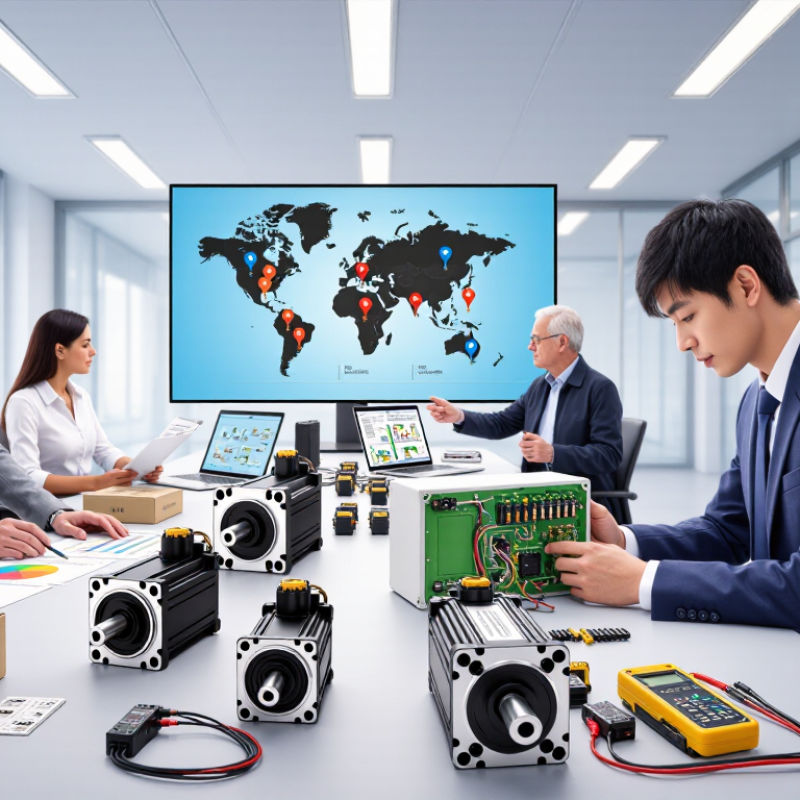
Modern servo drives combine power electronics, motion control, feedback processing, and industrial networking. Their core task is precise torque, speed, and position control. According to MarketsandMarkets, the global servo motors and drives market may reach about USD 18.5 billion by 2028, growing near 6.8% annually from 2023. This growth reflects demand for faster machines, smaller panels, and measurable energy savings.
The main product families serve different machine architectures. Compact single-axis drives suit packaging stations, conveyors, and laboratory equipment. Modular multi-axis drives share a common DC bus, reducing cabinet space and improving regenerative energy use. Integrated motor-drive units simplify wiring, but they can complicate maintenance in dusty production areas. High-performance families support advanced tuning, electronic gearing, cam profiles, and real-time industrial Ethernet. Functional safety features, including Safe Torque Off, help engineers design safer machine responses when correctly validated.
Details matter. A 400-volt drive may deliver excellent acceleration, yet poor cable shielding can create encoder noise. A 2024 report from Interact Analysis links factory automation investment with continuing demand for connected motion systems. Still, market forecasts are not field guarantees. Load inertia, ambient temperature, braking cycles, and commissioning skill change results. I have seen specifications look convincing until a machine cycles continuously at peak speed. That is the uncomfortable part. Suppliers should document thermal margins, firmware compatibility, service access, and tested motor-drive combinations. A reliable selection process compares those details, not only rated power or purchase price.
Technical reference table for evaluating servo-drive product families, control features, integration requirements, and application suitability
| Product Family | Typical Axis Configuration | Common Supply Range | Core Control Technology | Feedback Options | Communication and Motion Functions | Integrated Safety | Typical Applications |
|---|---|---|---|---|---|---|---|
| Compact Single-Axis Servo Drive | One motor axis per drive; cabinet or machine-mounted format | Typically 200–240 V AC or 380–480 V AC, three-phase | Closed-loop position, speed, and torque control; automatic motor identification may be available | Incremental encoder, absolute encoder, or resolver, depending on the motor and drive combination | Pulse-direction, analog reference, or real-time industrial network; point-to-point positioning | Safe Torque Off is commonly available; additional functions depend on the certified option set | Packaging machines, indexing systems, feeders, conveyors, and general machine automation |
| High-Performance Single-Axis Servo Drive | One axis with high dynamic response and precise synchronization | Commonly 200–240 V AC or 380–480 V AC, three-phase | High-bandwidth current, speed, and position loops with disturbance compensation and inertia adaptation | High-resolution absolute or incremental encoder; motor temperature sensing is often supported | Electronic gearing, camming, coordinated interpolation, homing, and cyclic synchronous operation | Safe Torque Off is typical; safe stop and safely limited speed require suitable certification and configuration | Robotics, printing, converting, semiconductor equipment, and high-speed assembly |
| Modular Multi-Axis Servo System | Multiple motor modules supplied from a shared power or DC bus | Typically 380–480 V AC input for medium- and high-power machine systems | Centralized motion coordination, regenerative energy management, and synchronized current control | Absolute and incremental feedback systems; feedback compatibility must be checked axis by axis | Multi-axis interpolation, virtual master, cam profiles, electronic line shaft, and synchronized motion | Safety functions can be implemented per axis or at system level, subject to the safety architecture | Machine tools, multi-axis handling, forming equipment, packaging lines, and complex production cells |
| Distributed Machine-Mounted Servo Drive | Single or dual axis installed close to the motor and machine mechanism | Often 200–240 V AC or 380–480 V AC, depending on regional power infrastructure | Decentralized closed-loop control with reduced cabinet wiring and local diagnostics | Digital encoder or resolver interfaces; connector and cable protection are important selection factors | Real-time industrial Ethernet, distributed clock synchronization, parameter access, and diagnostic messaging | Safety over the network or hardwired Safe Torque Off may be available, depending on the system design | Material handling, automated storage systems, machine modules, and space-constrained installations |
| Regenerative Servo Drive System | Single or multiple axes with frequent braking or overhauling loads | Usually medium-voltage industrial AC input with a shared DC link or active front end | Four-quadrant operation, controlled regeneration, and DC-bus energy balancing | High-resolution feedback recommended for vertical, tension, and rapid reversal applications | Coordinated braking, energy sharing among axes, synchronized speed control, and system monitoring | Safety functions depend on the drive modules, regenerative unit, and overall machine safety circuit | Elevators, test benches, winding machines, centrifuges, hoists, and high-inertia mechanisms |
| Cabinet-Integrated Servo and Motion Platform | Multiple drives, controller, power supply, and safety components in one engineered panel | Selected according to machine load, short-circuit rating, regional grid, and cabinet thermal design | Central motion controller with coordinated servo loops, PLC functions, diagnostics, and recipe management | Mixed feedback architectures may be used across different axes | Programmed motion sequences, synchronized axes, condition monitoring, remote diagnostics, and data logging | May support multiple safety functions when the controller, drives, and wiring are validated as a complete system | Complete production machines, automated lines, process equipment, and engineered turnkey systems |
| Low-Voltage DC Servo Drive | One axis, generally for compact mechanisms and battery-backed equipment | Commonly 24–80 V DC, subject to motor voltage and peak-current requirements | Closed-loop current, speed, and position regulation with current limiting | Incremental encoder, Hall sensors, or compact absolute feedback devices | Digital I/O, analog reference, serial communication, or compact industrial network interfaces | Basic disable inputs may be available; formal safety functions must be verified for the exact model | Mobile equipment, laboratory automation, medical mechanisms, and small-format machinery |
| Environmentally Protected Servo Drive | One or more axes in washdown, dusty, humid, or vibration-prone environments | Typically 200–240 V AC or 380–480 V AC, depending on the installation | Standard closed-loop servo control with thermal monitoring and enhanced fault diagnostics | Sealed encoder connections and feedback systems matched to the environmental rating | Industrial network communication, parameter backup, remote fault analysis, and synchronized motion | Safety availability depends on the certified enclosure, connectors, drive electronics, and installation method | Food and beverage machinery, pharmaceuticals, outdoor automation, and washdown production areas |
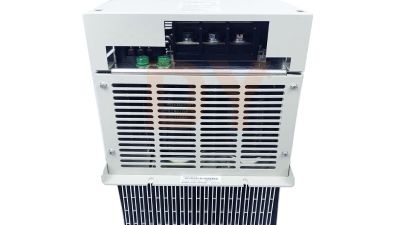
The MDS-B-CVE-450 is a 45 kW power supply unit and AC converter designed for CNC machine-tool power systems. It converts incoming AC power into a stable DC supply for compatible servo-drive and spindle-drive modules, supporting the coordinated operation of motors, axes, and machining functions. Its role within a multi-axis control cabinet makes it an important part of the electrical power chain, particularly in installations that require dependable energy delivery for demanding cutting, positioning, and speed-control tasks.
With a compact cabinet-oriented design, the unit can help organize power distribution and simplify integration with associated drive components. A 45 kW capacity provides substantial support for medium- and high-performance CNC equipment, while the converter architecture is intended to promote consistent operation during changing load conditions. For maintenance teams and machine builders, selecting a suitable replacement requires careful attention to rated capacity, input requirements, DC-bus compatibility, cooling conditions, wiring, and the specifications of connected drives. The MDS-B-CVE-450 is therefore suited to repair, refurbishment, and system-upgrade projects where reliable drive power is essential.
It controls motor torque, speed, and position. Motion must stay precise. Feedback signals guide corrections during operation.
A single-axis drive suits conveyors, packaging stations, and laboratory equipment. It uses less space. Check cabinet clearance and cooling before purchase.
It supports several motors through a shared DC bus. This can reduce cabinet space. It may also reuse regenerative energy. The design still needs careful braking calculations.
Confirm motor ratings, encoder type, network protocol, braking needs, and temperature limits. Request wiring diagrams and parameter lists. Small mismatches can create alarms or unstable motion.
Ask whether an engineer can calculate inertia matching and braking requirements. Request acceleration and emergency-stop examples. A vague answer is a warning.
Request current datasheets, revision records, test reports, and serial traceability. These records reveal stock control. Do not rely on verbal assurances.
Ask for insulation, encoder, and thermal inspection results. Check repair capacity and replacement terms. Packaging should protect connectors from moisture and impact. Perfect claims deserve skepticism.
For critical equipment, test one unit under realistic machine conditions. Measure temperature, noise, following error, and fault recovery. Keep the test record. I might still miss something. That is why review matters.
Ambient temperature, load inertia, braking cycles, and repeated peak-speed operation can change results. A drive may accelerate well once. Continuous cycling tells more.
This guide to the 2026 best Siemens Servo Drive suppliers for global buyers explains the core technologies, control functions, performance features, and product families used in modern motion-control systems. It outlines how to evaluate suppliers according to product quality, application expertise, customization capabilities, delivery reliability, pricing transparency, and after-sales technical support. The guide also compares different supplier types and regional market coverage to help buyers identify suitable sourcing channels for industrial automation projects.
In addition, the article highlights essential certification, compatibility, documentation, warranty, and global supply chain requirements. Buyers will learn how to verify communication interfaces, motor and controller matching, environmental ratings, spare-parts availability, and service responsiveness before placing an order. By following a structured selection and purchasing process, companies can reduce integration risks, control lifecycle costs, and choose a dependable Siemens Servo Drive supplier that supports stable operation and long-term maintenance across international markets.