Leave Your Message
Picking out a Delta Servo Motor isn’t just about matching the horsepower to your machine. You really need to think about whether the model responds smoothly under real-world conditions — things like sudden load changes, acceleration, heat, vibrations, and tight space inside the cabinet. A motor that looks perfect on paper might not perform well when you hook it up to a heavy vertical axis or a conveyor that stops all the time. Honestly, practical testing is a must.
In this guide, I’ll walk you through seven simple checks to help make sure you’re making a reliable choice. We're talking about things like matching torque requirements, covering your speed range, ensuring the inertia fits, verifying encoder feedback, checking drive compatibility, considering installation environments, and thinking about long-term support. Before you hit the buy button, it’s a good idea to go through Delta Electronics’ documentation, wiring diagrams, and product data. And if you’re unsure, chatting with an authorized distributor can give you a peace of mind—they can confirm whether all the parts, like the motor, servo drive, cables, and brakes, will actually work together.
Sometimes, small details make all the difference. If your workshop is dusty, you might need better protection. If the motor’s going on a vertical axis, you’ll probably want a holding brake. Running at high speeds could reveal tuning issues or excessive vibrations — stuff that might not show up on a brochure. So, always measure your actual machine. Seems obvious, but it’s surprisingly easy to overlook.
Of course, no buying guide is perfect. Sometimes application info is incomplete, and real machines never behave exactly like their laboratory test models. That’s why it’s smart to keep some wiggle room for verification, initial setup, and honest reassessment afterward. Comparing actual duty cycles with the model specs can save you from costly replacements later. Basically, these seven tips are designed to help you make smarter, more confident decisions, reduce the chances of incompatible parts, and pick out a Delta Servo Motor that really fits your needs with more clarity and peace of mind.
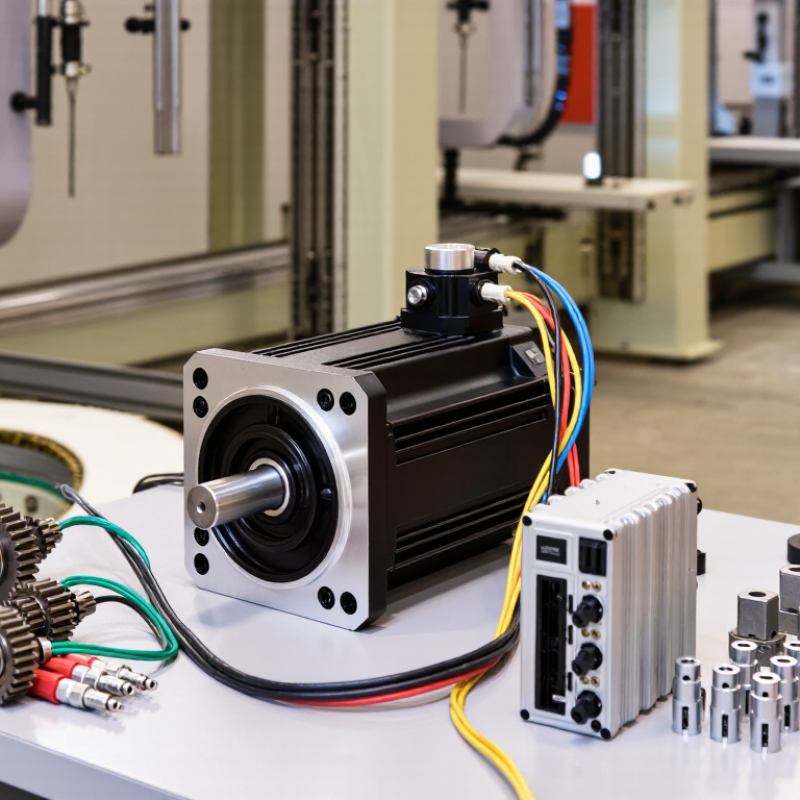
7 Tips for Buying a Delta Servo Motor
Define the Servo Motor’s Required Performance
Before comparing servo motors, translate the machine’s motion into measurable requirements. Record load mass, pulley radius, screw lead, acceleration, travel distance, and operating cycle. These details determine continuous torque, peak torque, speed, and motor inertia.
A useful starting point is the duty cycle. Calculate RMS torque across acceleration, movement, and stopping phases. Do not size only from the heaviest load. That approach often creates unnecessary heat and cost. Allow a practical safety margin, commonly 10% to 30%, but avoid oversized motors with poor low-load efficiency. The International Energy Agency reports that electric motor systems consume about half of global electricity, making correct sizing an energy concern, not only a purchasing decision.
Positioning needs equal attention. Define repeatability, accuracy, settling time, and encoder resolution in actual machine conditions. A high-resolution encoder cannot fix mechanical backlash, flexible couplings, or vibration. The International Federation of Robotics reported 541,302 industrial robots installed worldwide in 2023, showing the growing demand for controlled, repeatable motion. Yet published figures do not replace testing.
Check speed-torque curves at the intended voltage and temperature. Confirm overload duration, braking frequency, ambient conditions, and protection rating. I would also test the worst-case cycle before approval. Engineers sometimes trust catalog values too quickly. That mistake is easy to make. A short field trial may reveal resonance, noise, or thermal limits that calculations miss.
| Tip | Performance Factor | Selection Guidance | Useful Reference Data |
|---|---|---|---|
| 1 | Calculate Required Torque | Determine the torque needed to accelerate the load, overcome friction, and handle external forces. Select a motor whose continuous torque exceeds the calculated running torque and whose peak torque supports short-term acceleration or overload demands. | Basic relationship: T = F × r for linear or radial loads. For rotational acceleration, torque is also affected by the total reflected inertia and the required angular acceleration. |
| 2 | Match Rated and Maximum Speed | Compare the application’s normal operating speed, acceleration time, and maximum required speed with the motor’s rated and allowable speed. Avoid selecting a motor that must operate continuously at its limit. | Speed is commonly specified in revolutions per minute (rpm). Belt, pulley, gearbox, and leadscrew ratios change the motor speed required for a given machine speed. |
| 3 | Check Load Inertia and Inertia Ratio | Calculate the load inertia reflected to the motor shaft, especially when using belts, couplings, gearboxes, or leadscrews. A high mismatch between load inertia and rotor inertia can reduce response quality and make tuning more difficult. | Inertia is typically expressed in kg·m². A rigid mechanical design and an appropriate inertia ratio help reduce vibration, overshoot, and positioning instability. |
| 4 | Define Positioning Accuracy and Repeatability | Specify the required absolute accuracy, repeatability, resolution, and settling time before choosing the motor and feedback system. The complete mechanical system—not the motor alone—determines final positioning performance. | Accuracy describes closeness to the target position; repeatability describes consistency when returning to the same position. Backlash, shaft compliance, encoder resolution, and machine rigidity are important contributors. |
| 5 | Evaluate Duty Cycle and Thermal Load | Review the motion profile, including acceleration, constant-speed travel, deceleration, dwell time, and reversing frequency. Size the motor using continuous and root-mean-square torque rather than peak torque alone. | RMS torque is useful for estimating heating over a repeated cycle. A motor may produce high peak torque briefly, but continuous operation is limited by winding temperature and cooling conditions. |
| 6 | Select the Appropriate Feedback and Control Interface | Confirm the required feedback type, resolution, communication method, control mode, and compatibility with the servo drive or motion controller. Closed-loop feedback is generally required when accurate position, speed, or torque control is essential. | Common control modes include position, velocity, and torque control. Feedback devices may include incremental encoders, absolute encoders, or resolvers, depending on system requirements. |
| 7 | Verify Mechanical and Environmental Requirements | Check mounting dimensions, shaft configuration, holding brake requirements, permissible radial and axial loads, cable routing, installation orientation, ambient temperature, humidity, dust, and washdown exposure. | Ingress protection ratings indicate resistance to solid particles and water. The required rating depends on the installation environment; environmental protection should be confirmed for the complete motor and connector assembly. |
Start with the real machine load, not an optimistic estimate. Measure payload, friction, acceleration, stopping time, and shaft speed. Calculate continuous torque and peak acceleration torque. The motor must handle both ranges comfortably. Do not select by wattage alone.
Starting torque can be higher than expected. Rapid indexing may cause vibration, heat, or inaccurate stops. Test the heaviest expected load. A sensible margin helps, but excessive oversizing can reduce responsiveness and increase energy use.
Record belt tension with a spring scale. Check reflected inertia, gearbox ratio, and duty cycle. Watch the shaft speed during acceleration. Small design changes can significantly alter torque demand.
Confirm controller speed range, encoder resolution, mounting dimensions, shaft size, and available voltage. Check cable and brake requirements. Review cabinet temperature, because hot air matters.
Check the model code, serial number, sealed packaging, and technical documents. Match the label with the quotation and invoice. Request clear product photos before payment. One missing digit may change voltage or encoder type.
Compare at least three written quotations. Review technical support, delivery reliability, inventory, and replacement availability. Confirm freight, taxes, accessories, and commissioning support. My first comparison was too narrow.
Confirm the coverage period and starting date. Check whether repairs, parts, or complete replacement are included. Ask about return shipping and the claim process. Review exclusions for overload, moisture, wiring errors, and poor storage.
Include the drive, cables, software, installation, brake options, and energy use. A cheaper motor may need expensive accessories. Also consider spare parts and service delays. The invoice is only one part.
Request manuals, wiring diagrams, parameter lists, and setup guidance before ordering. Ask who handles urgent faults and how quickly they respond. Local replacement units can reduce downtime. Forecasts can fail, especially during shortages.
A short test is useful. It is not proof. Monitor current, temperature, noise, and settling time. Production may add dust, shock, or repeated acceleration. Recheck the calculation when the mechanism changes.
Choosing the right Delta Servo Motor requires more than comparing horsepower or price. Start by defining the required speed, torque, positioning accuracy, duty cycle, and operating conditions of your application. Then confirm that the motor’s specifications match the drive system, including voltage, current, communication method, and control functions. Select a suitable motor size and torque range to avoid overheating, poor response, or unnecessary energy use. It is also important to check encoder type, feedback resolution, and controller compatibility before purchase.
Before making a final decision, verify the mounting dimensions, shaft configuration, protection rating, and allowable environmental conditions. Compare genuine products from reliable suppliers by reviewing warranty coverage, documentation, delivery reliability, and technical support. Finally, evaluate total cost rather than purchase price alone, including installation, maintenance, spare parts, availability, and expected service life. A careful selection process will help ensure stable performance, easier integration, and dependable long-term operation.