
- Linear scales measure true linear motion; encoders usually measure motor rotation, so the error chain is different.
- For high-precision feedback, the physical measurement point matters more than brand names alone.
- Retrofit success depends on controller compatibility, signal format, and installation tolerances.
- Use encoder feedback for simpler servo control; use a Fagor linear scale when machine-level accuracy is the priority.
- Following ISO 230-2:2014 and NIST guidance on precision linear and angular displacement helps frame accuracy testing objectively.
For precision measurement in CNC feedback systems, the central question is not whether a Fagor linear scale or an encoder is inherently better, but which one closes the loop at the point that matters most. In practice, that distinction can be the difference between a machine that repeats within a few micrometers and one that still inherits ballscrew pitch error, backlash, or thermal drift. ISO 230-2:2014 defines positioning accuracy and repeatability testing for machine tools, while many modern linear scale systems offer submicron resolution options, commonly down to 0.1 µm or 1 µm depending on the scale and controller architecture.
If you are evaluating replacement parts, compatibility matters as much as metrology. A feedback device only performs well when the interface, signal type, mounting method, and control logic match the existing machine architecture. That is why buyers often compare the scale or encoder together with the rest of the axis stack, including the servo drive, the servo motor, and the linear scale category before they decide on a retrofit path.
Fagor Linear Scale vs Encoder Feedback: what each device actually measures
The biggest technical difference is the measurement location. A linear scale measures linear displacement directly along the axis, while an encoder usually measures rotary motion on the motor shaft or ball screw.
That difference matters because machine error is cumulative. Backlash, elastic deformation, screw error, coupling slip, and thermal growth all sit between the motor and the tool tip. When the feedback device is mounted only on the motor, the control system may correct the motor position but still miss what the table is actually doing. With a linear scale, the controller sees the true axis position and can compensate more directly.
| Feedback Type | Measurement Point | Typical Resolution | Main Advantage | Main Limitation |
|---|---|---|---|---|
| Fagor linear scale | Table or slide | 0.1 µm to 1 µm | Measures actual axis position | Higher installation sensitivity |
| Rotary encoder | Motor shaft or screw | 1,000 to 20,000 counts per rev, often higher with interpolation | Simpler and lower cost | Does not directly remove mechanical chain error |
| High-resolution absolute encoder | Motor shaft | Up to multi-turn absolute systems | Fast homing and robust feedback | Still indirect for table position |
For many shops, the key phrase is encoder feedback. It is the standard architecture in servo systems because it is compact, fast, and reliable. Yet when a machine needs tighter geometry control, especially on long travel axes, a Fagor linear scale can reduce the gap between commanded position and actual cut position.
Why precision measurement favors the feedback point, not just the resolution
Precision measurement is not only about how fine a signal is; it is about how faithfully that signal represents real motion.
An encoder with very high counts can still report an axis position that differs from the cutter position if the screw expands, the coupling slips, or the machine structure deflects under load. A linear scale bypasses much of that by measuring the moving axis directly. This is why machine builders often place linear encoders on the primary positioning axes of high-end milling machines, jig grinders, and inspection systems.
According to NIST guidance on displacement metrology, linear measurement systems must account for interpolation, scale error, alignment, and environmental effects. That is important because a feedback system is only as good as its calibration and installation. A scale mounted with poor squareness or contamination protection can lose much of its theoretical advantage, even if the sensor itself is excellent.
From a machining standpoint, this is especially visible when a machine runs long cycles, large parts, or temperature-sensitive workpieces. In those cases, the axis position error is often not random; it is systematic. A linear scale can help the control loop correct that error before it becomes a scrap part.
When a Fagor linear scale is the better choice
A Fagor linear scale is usually the better choice when actual machine position matters more than simplicity.
That includes precision milling, mold and die work, grinding, high-end inspection, and machines that must maintain accuracy after thermal expansion. Linear scales are also a strong option when the ballscrew is long, the load is variable, or the machine structure is prone to compliance error. In those situations, motor feedback alone can leave too much uncertainty at the tool point.
A useful rule is this: if the customer complaint sounds like “the servo is fine, but the part still comes out dimensionally unstable,” then the problem may be the feedback location rather than the drive tuning. A linear scale moves the feedback loop closer to the actual cut.
| Application Scenario | Preferred Feedback | Why | Typical Risk if Chosen Wrong |
|---|---|---|---|
| High-precision milling | Linear scale | Direct position measurement | Uncompensated screw and backlash error |
| General-purpose turning | Encoder | Good enough for most motion loops | Unnecessary cost if accuracy demand is moderate |
| Long-axis machines | Linear scale | Reduces accumulated mechanical error | Dimensional drift over travel |
| Retrofit with limited space | Encoder | Easier installation | Lower machine-level accuracy |
For retrofit buyers, it is worth checking whether the machine already uses a control architecture designed for direct position feedback. If not, upgrading to a scale may require changes to the controller, wiring, and servo loop configuration. That is why many maintenance teams review the Fagor CNC controls compatibility path before ordering the sensor itself.
When encoder feedback is the smarter choice
Encoder feedback is the smarter choice when speed, simplicity, and cost control are more important than absolute machine position accuracy.
Encoders are excellent for servo commutation, velocity control, homing, and general closed-loop motion. They are compact, easier to integrate, and often less exposed to contamination than external scales. For many production machines, especially where tolerances are moderate, an encoder delivers the best value-to-performance ratio.
This is why encoder-based systems remain dominant in industrial automation. The control loop is shorter, installation is simpler, and troubleshooting is often faster. In a downtime-sensitive environment, that can matter more than theoretical accuracy gains.
However, encoder feedback should not be confused with machine-level metrology. If the encoder is on the motor, it cannot directly see lost motion in the screw or deflection in the axis structure. That is the trade-off.
- Choose encoder feedback when the machine needs stable motion control and straightforward maintenance.
- Choose linear scales when the process requires direct position verification at the slide or table.
- Choose neither without confirming interface type, supply voltage, and control compatibility.
- Use the machine drawing and controller manual before ordering replacement parts.
Installation factors that decide real-world accuracy
The best feedback device can underperform if the installation is weak.
Linear scales require careful alignment, contamination protection, stable mounting surfaces, and proper cable routing. Encoders require clean electrical integration, shielded wiring, and correct resolution settings. In both cases, signal integrity can make or break performance.
On the electrical side, the controller must recognize the signal format. Incremental encoders may use differential A/B/Z signals, while many linear scales use proprietary or dedicated digital interfaces depending on the control ecosystem. If the feedback format does not match the controller, the machine may alarm, miscount, or refuse to close the loop.
That is why spare parts procurement is not just about part number matching. The buyer must verify model, interface, cable length, connector style, and the control logic expected by the machine. In CNC maintenance, a seemingly small mismatch can turn into an hour-long outage or a full axis fault.
| Selection Check | Linear Scale | Encoder | Why It Matters |
|---|---|---|---|
| Signal format | Must match controller protocol | Must match drive input | Wrong interface causes alarms |
| Mounting tolerance | High sensitivity to alignment | Moderate sensitivity | Misalignment creates measurement error |
| Contamination risk | Higher if exposed | Usually lower | Chip coolant and dust affect reliability |
| Retrofit effort | Higher | Lower | Time-to-recovery matters in maintenance |
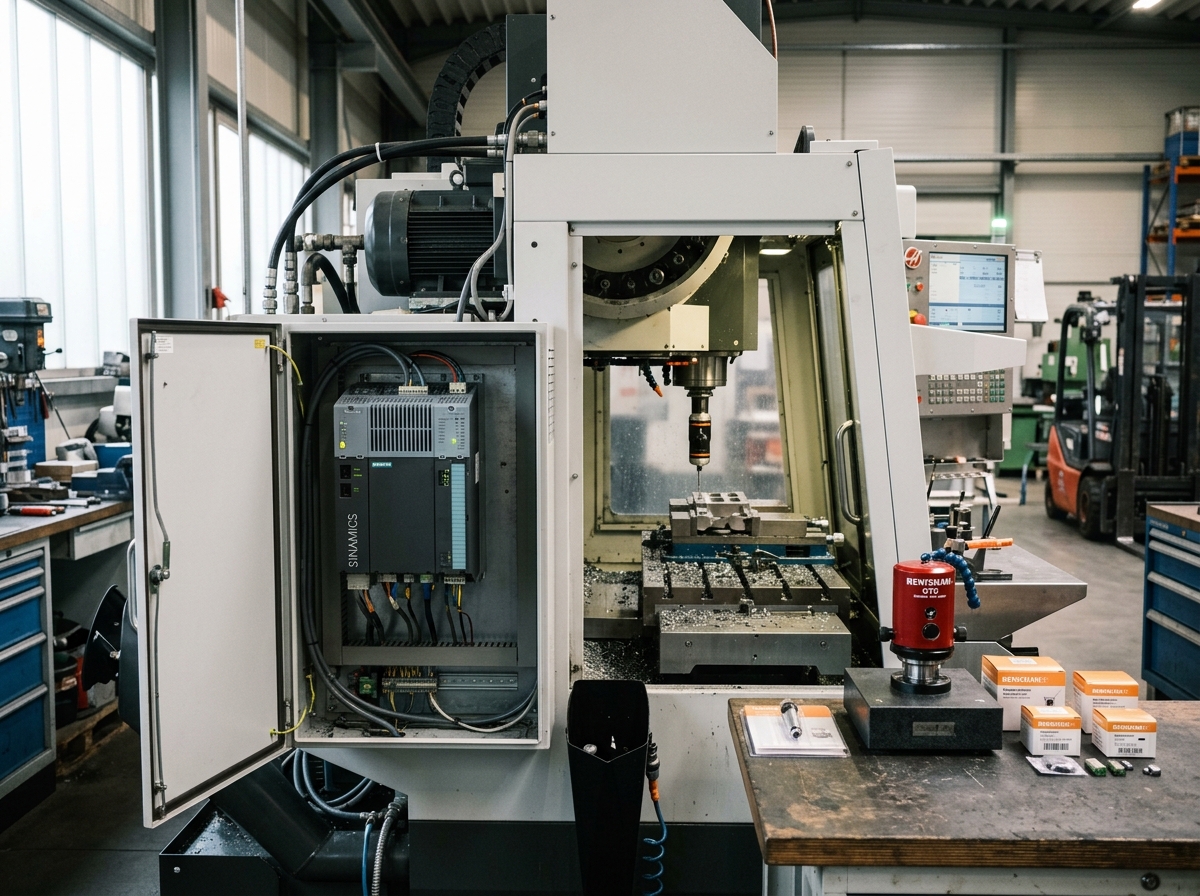
When the goal is a controlled retrofit, many buyers combine the feedback device with the right peripheral parts, such as the I/O modules for signal integration and the power supply units for stable system voltage. Stable power is not glamorous, but unstable supply can create false alarms that look like encoder or scale failure.

Precision measurement standards and how to compare claims
Claims about precision are only useful when you know how they were measured.
ISO 230-2:2014 is a key reference for testing positioning accuracy and repeatability of CNC machine tools. It helps separate marketing language from measurable performance. If a supplier says a linear scale provides better precision, the real question is whether that advantage appears in machine tests under controlled conditions.
Another useful reference is ISO 230-1:2012, which addresses geometric accuracy tests for machine tools. In practice, geometric and positioning errors interact, so a better feedback system cannot fully rescue a mechanically poor machine. It can reduce one error source, but not all of them.
For displacement metrology, the NIST length metrology resources are helpful when assessing calibration and traceability. If your process requires audit-ready measurement, traceability is as important as raw resolution.
Here is the practical takeaway: a 1 µm resolution number is not the same as 1 µm machine accuracy. Resolution is the smallest step the system can detect; accuracy is how close the machine gets to the intended position. Linear scales improve the path from one to the other, but only if the entire feedback loop is well designed.
How to choose between Fagor linear scale and encoder feedback
The best choice depends on the machine, the tolerance target, and the cost of an error.
If a dimensional miss costs a high-value part, a regrind, or a customer rejection, the more direct feedback path usually pays back faster. If the machine is a standard production asset where uptime and simplicity matter more, encoder feedback may be the better operational decision.
- Define the tolerance target in micrometers, not in vague quality terms.
- Check whether the control system supports direct scale input.
- Assess contamination exposure, travel length, and thermal growth risk.
- Compare installation time, spare parts availability, and service skill level.
- Decide whether you need axis-level control or motor-level control.
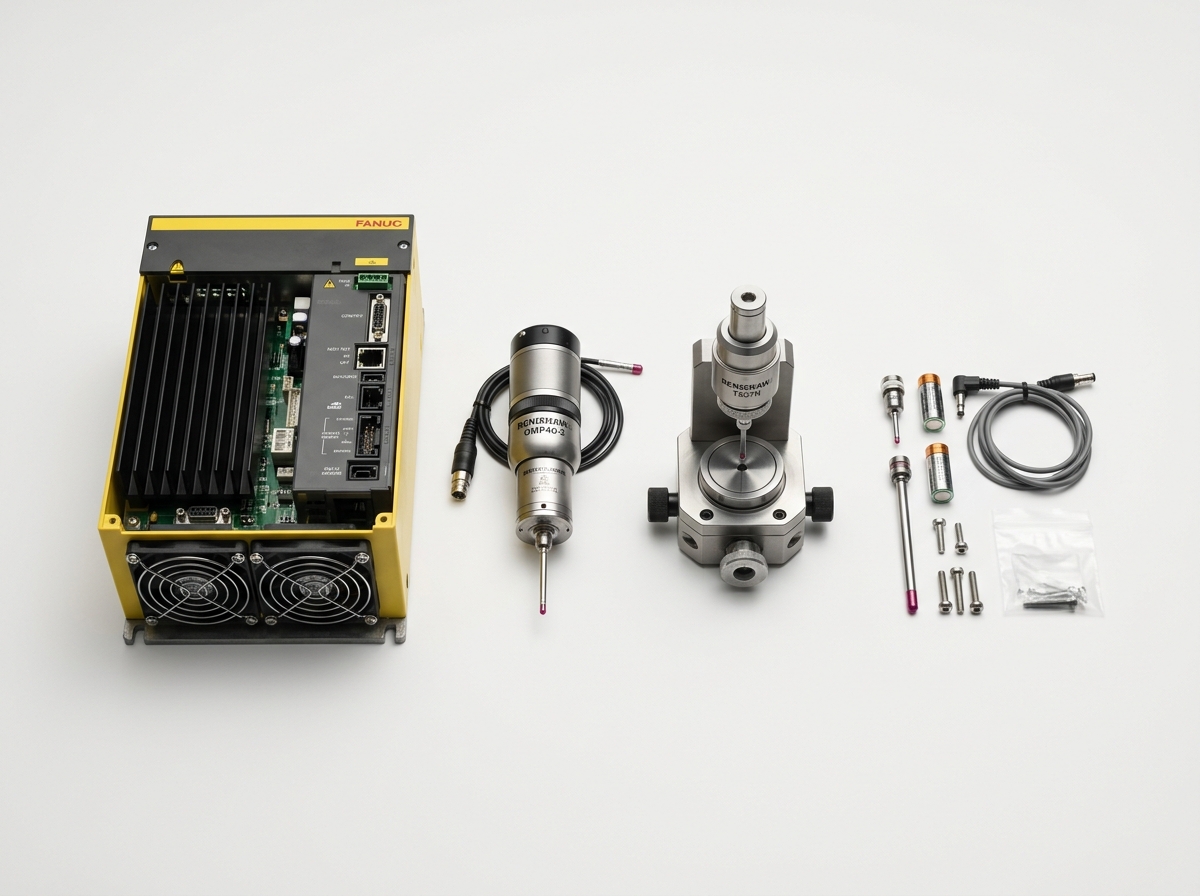
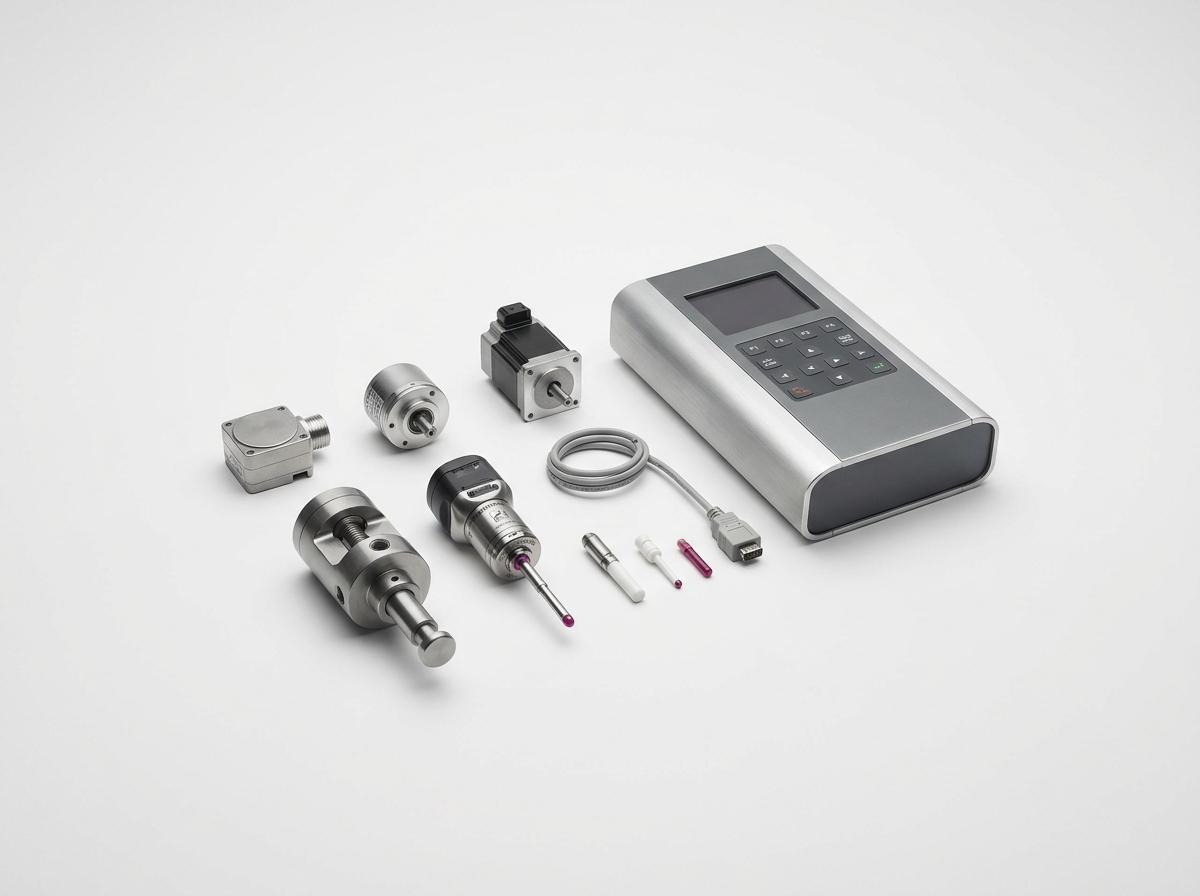
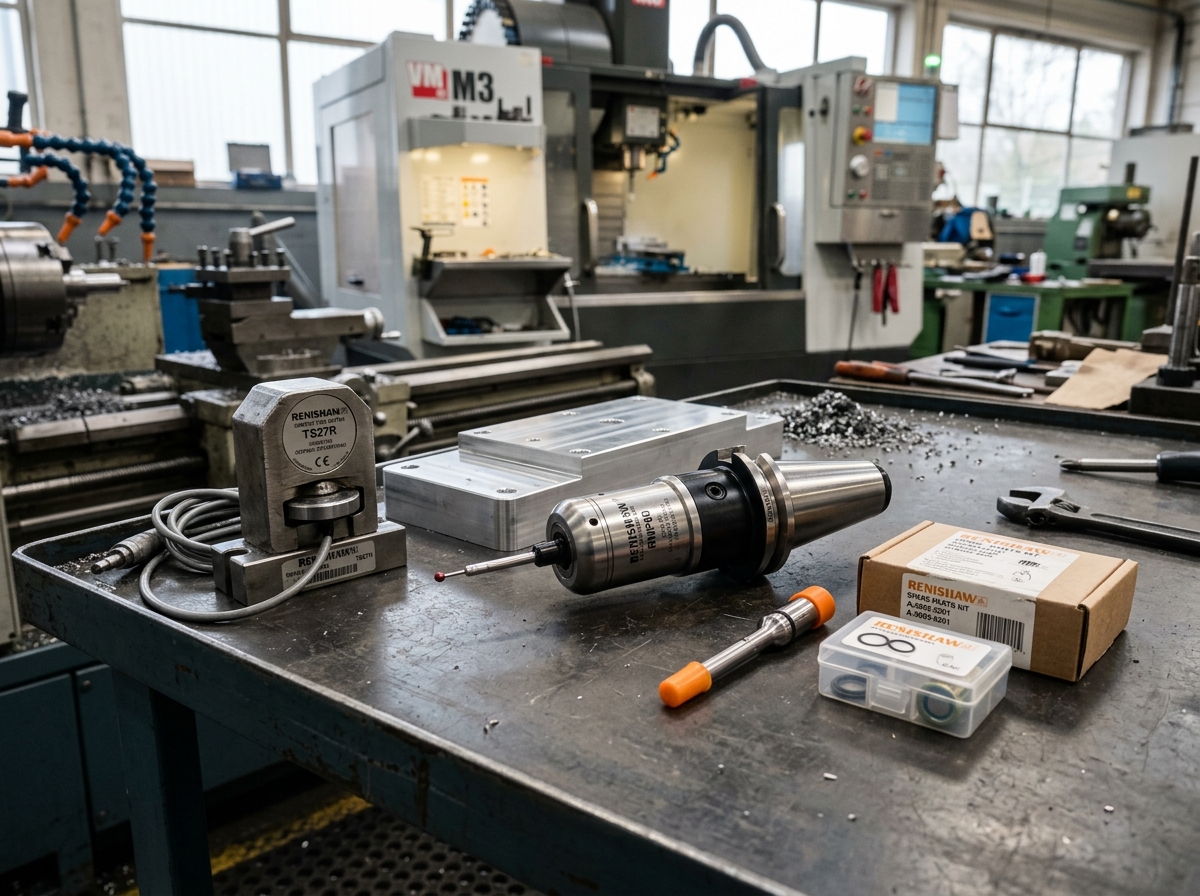
For shops that are building a spare-parts strategy, the feedback device should be considered alongside motion and measurement components such as the encoder catalog, the linear scales catalog, and the probe systems. That broader view reduces mismatches and helps maintenance teams restore accuracy faster.
Common mistakes when replacing precision feedback parts
The most common mistake is assuming that any encoder can replace any scale, or vice versa.
Another mistake is focusing only on resolution. A 24-bit encoder or submicron scale still fails if the controller cannot interpret it correctly, the cable is noisy, or the mounting bracket flexes under load. The third mistake is ignoring the mechanical path. If the axis has measurable backlash or wear, feedback at the motor may hide the symptom without solving the cause.
A fourth mistake is skipping verification after replacement. After installation, the machine should be checked for positioning accuracy, repeatability, and thermal stability under actual production conditions. That is where ISO-based test methods provide value.
- Do not buy by part number alone.
- Do not ignore connector and interface standards.
- Do not assume resolution equals accuracy.
- Do not skip post-installation validation.
Bottom line for precision measurement
The best precision feedback is the one that measures the error you actually care about.
If your priority is machine-level accuracy at the table or tool point, a Fagor linear scale is usually superior because it closes the loop on real linear motion. If your priority is a robust, economical, and simpler servo feedback system, an encoder is often the better engineering choice. In both cases, the winning decision comes from matching the feedback architecture to the control system, the application tolerance, and the maintenance reality of the shop floor.
For buyers and maintenance teams, the safest approach is to validate the controller, wiring, installation constraints, and measurement target before ordering. That is the difference between a spare part that restores performance and a spare part that creates a new alarm.
FAQ
Is a Fagor linear scale always more accurate than an encoder?
Not always, but it usually provides more accurate machine-level position feedback because it measures the linear axis directly instead of the motor shaft.
Does an encoder feedback system work for precision machining?
Yes, if the process tolerance is moderate and the machine mechanics are stable. For tighter tolerances, linear feedback is often better.
Can a linear scale fix backlash?
It can reduce the effect of backlash in the control loop, but it does not remove the mechanical wear itself.
What resolution should I look for in precision measurement?
Resolution depends on the application, but many high-precision systems use 1 µm or finer, with some scale systems offering 0.1 µm class feedback.
Which is easier to retrofit, a scale or an encoder?
An encoder is usually easier to retrofit because it is more compact and less demanding mechanically.
What standards should I use to compare machine accuracy claims?
Start with ISO 230-2:2014 for positioning accuracy and repeatability, and ISO 230-1:2012 for geometric accuracy.
What should I verify before ordering a replacement feedback device?
Confirm the model, signal format, connector type, mounting dimensions, controller compatibility, and cable specification before purchase.