










FANUC's 5-Axis: A Digital Wall for China?
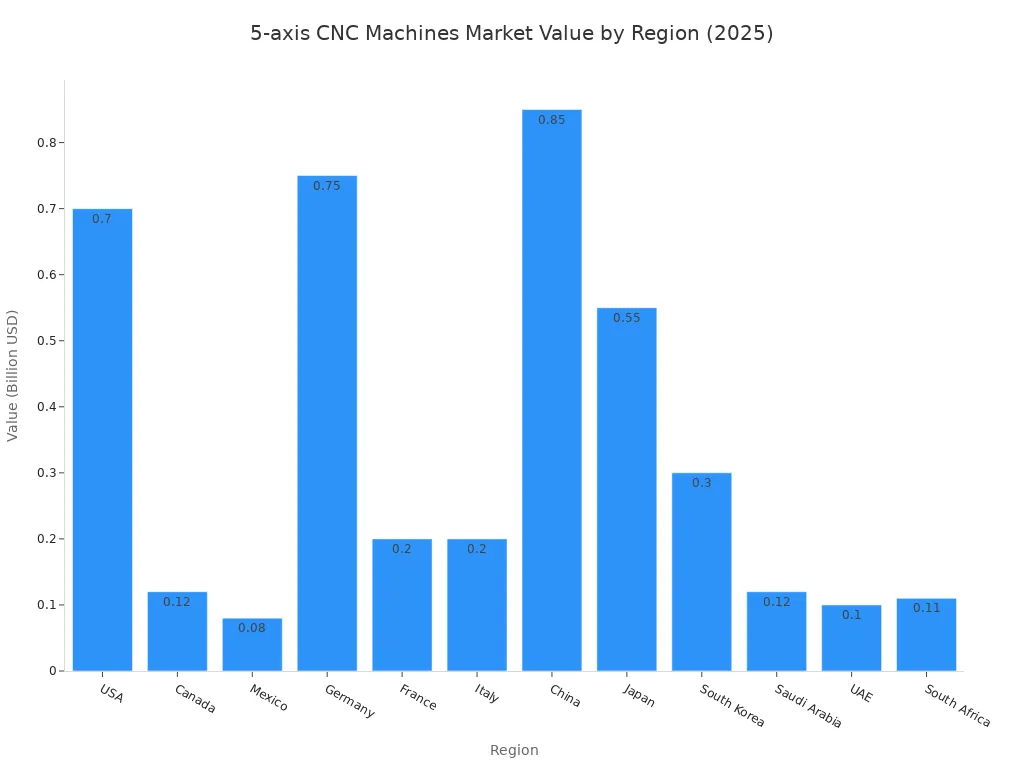
FANUC's advanced FIVE-AXIS linkage system is not openly available to China. This restriction stems from international export control regulations. National security concerns also drive these limitations. The technology has both civilian and military applications. This dual-use nature makes it highly sensitive. The global market for 5-axis CNC machines highlights its importance. Asia-Pacific holds 42% of this market. China itself represents a significant portion, with a projected market value of $0.85 billion in 2025.
Key Takeaways
- FANUC's advanced 5-axis systems are not sold to China due to international export rules.
- These restrictions exist because the technology can be used for both civilian and military purposes.
- The Wassenaar Arrangement is a key international agreement that controls sensitive technology transfers.
- FANUC's advanced controllers, motors, and software are critical parts of its 5-axis systems.
- Governments limit access to this technology to prevent military growth and keep global power balanced.
- China is investing a lot in its own research to build its own 5-axis technology.
- These restrictions push China to find new ways to make advanced products, like using other partners or methods.
- The limits on technology are changing how goods are made and traded around the world.
The Foundation of Restriction: Export Controls and Dual-Use Technology

The global community restricts certain technologies to prevent their misuse. These restrictions form the basis of export controls. They aim to manage the spread of sensitive items.
Understanding International Export Control Regimes
The Wassenaar Arrangement's Mandate
The Wassenaar Arrangement is a key international agreement. It promotes transparency and responsibility in transfers of conventional arms and dual-use goods and technologies. However, the Arrangement has faced difficulties. It struggles to update its control lists for advanced manufacturing technologies. This is due to its consensus-based decision-making process. Russia's actions have stalled progress since 2022. This prevented the addition of technologies like quantum computers and metal additive manufacturing equipment to its control list for two full cycles in 2023 and 2024. Because of this inability to reach consensus, individual member states have started implementing their own national controls. For example, Spain controls quantum computers with more than 34 qubits. The Netherlands controls equipment for manufacturing advanced-process-node semiconductors. The US controls AI chips and technology, along with lasers and cameras for certain additive manufacturing.
Multilateral Export Control Frameworks
Beyond the Wassenaar Arrangement, other multilateral frameworks exist. These frameworks work to control the export of sensitive technologies. They ensure that advanced capabilities do not fall into the wrong hands. These agreements help maintain global security. They also prevent the proliferation of technologies with military potential.
The Dual-Use Dilemma of FANUC's 5-Axis Systems
Five-axis systems present a unique challenge. They offer significant benefits for civilian industries. They also hold critical importance for military applications. This dual nature makes them subject to strict controls.
Civilian Applications in Advanced Manufacturing
Five-axis CNC machines are vital for modern manufacturing. They create complex parts for many industries. For example, they produce intricate components for aerospace engines. They also make precise medical implants. These machines improve quality and reduce production time. They also cut costs in the manufacturing process. Their ability to machine complex geometries in a single setup makes them highly efficient.
Military Applications in Defense Production
The precision and versatility of 5-axis CNC machining are crucial for defense. These machines create components for military equipment. This includes bearings, bolts, and missile components. They also make parts for naval engines and aircraft. A complex gear component for a hydraulic system in the defense industry, for instance, required a 5-axis CNC mill machine. This component needed exact specifications and extraordinary detail. Five-axis CNC machining offers unmatched precision for critical components. It achieves micron-level accuracy for engine parts and structural elements. This ensures reliability for mission-critical applications. It also creates intricate designs like contoured surfaces without multiple setups. This streamlines production and minimizes errors. The technology supports a wide range of materials. These include titanium, aluminum, and advanced composites. This allows for strong, lightweight components in defense systems.
Specific FANUC Components Under Scrutiny
The restrictions on 5-axis technology often focus on specific components. These parts give the systems their advanced capabilities.
Advanced CNC Controllers
FANUC CNC controllers are central to 5-axis precision. They achieve a precision of ±0.001 mm. This ensures parts match CAD files perfectly. Thermal compensation helps maintain reliability during long operations. These controllers manage over 32 axes simultaneously. This makes them ideal for 5-axis machining. They synchronize all axes to eliminate jerkiness and preserve surface quality. Programming for 5-axis machines becomes simpler with functions like Workpiece Setting Error Compensation (G54.4) and Tool Center Point (G43.4/G43.5). These functions remove complex post-processor math. They allow for machine-independent part programs. Advanced algorithms like AI Contour Control (G5.1 Q1) and Smooth Tolerance Control (G5.1 Q3) use real-time spline look-ahead. They interpret CAM points as smooth splines. This leads to more accurate parts, better surface finish, and shorter cycle times. The Easy Setting Function (G8.1 PX) allows programrs to define dynamic profiles for tool paths. This optimizes performance for different processes. Integrated probing routines also facilitate automatic kinematic calibration. They ensure precise part location. This is crucial for accurate 5-axis contouring.
High-Precision Servo Motors and Drives
High-precision servo motors and their drives are essential. They provide the exact movements needed for 5-axis machining. These components ensure the machine axes move with incredible accuracy and speed. They respond instantly to controller commands. This precise control is vital for producing complex shapes and smooth surfaces. Without these advanced motors and drives, the full potential of 5-axis systems would not be realized.
Integrated Software and Algorithms
The software and algorithms integrated into 5-axis systems are equally critical. They translate design data into machine movements. Key algorithms include Tool Center Point (TCP) and Workpiece Setting, Error Compensation (WSEC). The Easy Setting Function allows for multiple acceleration and process profiles. Advanced lookahead algorithms, such as AICC II with Smooth Tolerance Control+, predict tool paths. They ensure smooth and accurate motion. Artificial intelligence contour control (G05.1) and Tilted Working Plane Command (G68.2) further enhance precision. These sophisticated algorithms enable the machine to handle complex geometries. They maintain high accuracy throughout the machining process.
Geopolitical Imperatives: National Security and Strategic Competition
Nations often restrict advanced technologies for reasons of national security. They also do this to maintain a competitive edge. These geopolitical imperatives shape the availability of systems like FANUC's 5-axis technology.
Preventing Proliferation of Advanced Capabilities
Governments aim to control the spread of powerful technologies. This prevents potential adversaries from gaining military advantages.
Limiting Military Modernization
Restricting access to 5-axis technology directly limits military modernization. This technology is crucial for making precise components for advanced weaponry. Without it, a nation struggles to produce high-quality parts for aircraft, missiles, and other defense systems. This slows down their ability to upgrade military capabilities.
Maintaining Global Strategic Balance
Controlling advanced technology helps maintain a global strategic balance. If one nation gains a significant technological lead, it could disrupt international stability. Export controls ensure that no single power can easily dominate in critical defense areas. This promotes a more stable international environment.
Preserving Technological Superiority
Western nations work to protect their technological lead. They see this as vital for economic and security interests.
Protecting Western Innovation Ecosystems
Restrictions protect the innovation ecosystems of Western countries. These ecosystems include research institutions, companies, and skilled workers. They develop cutting-edge technologies. Limiting access to these innovations prevents other nations from simply copying or quickly catching up. This safeguards intellectual property and encourages continued domestic research and development.
Slowing Competitor Technological Advancement
These restrictions also aim to slow down the technological advancement of competitors. An entrepreneur noted a 'throat-cutting' issue in high-end three-axis systems. Five-axis systems, crucial for precision equipment, face similar international challenges. An industry expert explicitly stated that "Five-axis CNC systems are unequivocally not available for sale to China." This is due to restrictions like the Wassenaar Arrangement and COCOM. This forces Chinese enterprises to demonstrate non-military use to Western counterparts. This highlights ongoing technological isolation. Japan has consistently refrained from selling its five-axis CNC machine tools to China since entering the market. They cite the Wassenaar Arrangement. This directly hinders the availability of advanced technology. It impacts China's technological development and contributes to its 'Middle-technology Trap.' Furthermore, Taiwanese machine-tool industries can use Generative AI for optimization. However, Chinese enterprises cannot use Western Generative AI tools due to geopolitical considerations. This diminishes their competitiveness. Despite efforts, a significant gap remains in the performance of China's domestic five-axis systems compared to foreign manufacturers. Domestic systems often have bugs and lack the refinement of Western counterparts. Western systems have benefited from over a century of development. This underscores the disadvantage China faces as a latecomer in the industry due to these restrictions.
The US-China Tech Rivalry and FANUC's Position
The broader geopolitical landscape, especially the US-China tech rivalry, heavily influences technology access.
Broader Geopolitical Tensions
The US and China are engaged in a broad geopolitical competition. Technology is a key battleground in this rivalry. Both nations seek dominance in critical areas. This competition affects trade, diplomacy, and technology transfer policies.
Strategic Competition in Critical Technologies
Five-axis technology is a critical area in this strategic competition. It enables advanced manufacturing across many sectors. Companies like FANUC find themselves in a difficult position. They must navigate international regulations and national security concerns. Their advanced systems become a focal point in the struggle for technological leadership.
FANUC's Operational Stance: Compliance and Risk Mitigation
Companies like FANUC operate in a complex global environment. They must balance business goals with strict international regulations. This section explores how FANUC manages these challenges.
FANUC's Adherence to International Law
FANUC prioritizes following international laws. This ensures they operate responsibly worldwide.
Compliance with Export Control Regulations
FANUC strictly adheres to export control regulations. These rules govern the transfer of sensitive technologies across borders. They include guidelines from international agreements and national laws. The company implements robust internal controls. These systems ensure their products do not reach unauthorized end-users or destinations. This commitment helps prevent the misuse of their advanced technology.
Avoiding Sanctions and Legal Repercussions
Violating export controls carries severe penalties. Companies face hefty fines, trade restrictions, and reputational damage. FANUC actively works to avoid these sanctions. They maintain a strong legal and compliance team. This team monitors changes in international law. They also educate employees on compliance requirements. This proactive approach protects the company from legal repercussions.
Risk Mitigation for FANUC's Intellectual Property
Protecting valuable intellectual property is crucial for technology leaders. FANUC takes steps to safeguard its innovations.
Protecting Proprietary Technology
FANUC invests heavily in research and development. Their advanced 5-axis systems contain unique designs and software. The company uses patents, copyrights, and trade secrets to protect these innovations. They also implement strict internal security measures. These measures prevent unauthorized access to their proprietary technology. This ensures their competitive edge in the market.
Managing Supply Chain Vulnerabilities
Controlling the entire supply chain presents a significant challenge. Even with strict export controls, vulnerabilities can arise. Reports indicate that Japanese brands, including fanuc, have reportedly supplied CNC machines to Russia through indirect channels. This activity occurs despite geopolitical issues and sanctions. It highlights the difficulty in preventing circumvention of export controls. Such incidents pose a risk to companies like FANUC. They must continuously monitor their distribution networks. This helps ensure their products do not end up in unauthorized hands.
Balancing FANUC's Business Interests with Compliance
FANUC must navigate a delicate balance. They aim for global market success while upholding ethical and legal standards.
Navigating Global Market Demands
The global market for advanced manufacturing technology is vast. Many countries seek access to 5-axis systems for their industries. FANUC must meet these demands while respecting export restrictions. They carefully assess each potential sale. This ensures compliance with all regulations. They also seek opportunities in compliant markets.
Ethical Considerations in Technology Transfer
Technology transfer involves ethical responsibilities. Companies must consider the potential impact of their products. This includes both civilian and military applications. FANUC makes decisions based on these ethical considerations. They aim to contribute positively to global industry. They also avoid actions that could undermine international security.
Implications for China's Manufacturing and Innovation Landscape
Restrictions on advanced 5-axis technology significantly impact China. They shape its manufacturing capabilities and drive its innovation strategies. China faces both challenges and opportunities in this environment.
Impact on China's High-Precision Manufacturing Sectors
The lack of open access to advanced 5-axis systems creates specific difficulties for China. These challenges affect key industrial areas.
Challenges for Aerospace and Defense Industries
China's aerospace and defense industries face significant hurdles. These sectors rely heavily on high-precision manufacturing. They need 5-axis machines to produce complex components. These parts include turbine blades, missile casings, and structural elements for advanced aircraft. Without access to top-tier foreign systems, these industries must develop their own. This slows down their modernization efforts. It also affects the quality and performance of their military equipment.
Limitations in Advanced Industrial Production
The restrictions extend beyond military applications. They also limit China's advanced industrial production. Many high-tech sectors require precise machining. These include medical devices, advanced robotics, and semiconductor equipment. Companies in these fields struggle to produce intricate parts efficiently. This can increase production costs. It also affects the competitiveness of Chinese products in global markets.
Driving China's Domestic Innovation in 5-Axis Technology
The restrictions have also spurred China to invest heavily in its own technological development. This aims to achieve self-reliance.
Government Investment in Indigenous R&D
The Chinese government has prioritized indigenous research and development. It allocates substantial resources to overcome technological bottlenecks. This includes funding for universities and research institutions. They focus on developing domestic 5-axis machine tools and control systems. The goal is to reduce dependence on foreign suppliers. This strategic investment aims to build a robust domestic industry.
Development of Local 5-Axis Solutions
China has made progress in developing its own 5-axis solutions. However, a significant gap remains in high-precision fields. International giants have historically monopolized true five-axis linkage machine tools. This is due to the high technical threshold. The accuracy retention of rotary tables and tilting heads poses particular challenges. Experts acknowledge that China can produce cost-effective machines. Yet, achieving the precision and capabilities of international counterparts in core, high-end areas will take time. The precision requirements for different applications vary dramatically. Manufacturing simpler components does not translate to the capability for highly complex parts. These include components for semiconductor equipment.
Despite these challenges, China's CNC services achieve high precision levels. For high-end applications, tolerances often reach ±0.005 mm. For aerospace components like compressor blades, precision can be as tight as ±0.001 mm. These machines operate with spindle speeds ranging from 15,000 to 50,000 rpm. Cutting feed rates exceed 60 m/min. This enables the production of intricate geometries. They also handle materials like titanium alloys.
China's Alternative Solutions and Workarounds
China employs various strategies to circumvent restrictions. These include reverse engineering and seeking alternative partnerships.
Reverse Engineering and Indigenous Development
China has historically pursued reverse engineering. This helps it acquire advanced technology. In 1993, China National Aero-Technology Import and Export Corporation (CATIC) agreed to purchase 19 machine tools. These included 5-axis machines, from McDonnell Douglas. They initially intended these for the Trunkliner Program. This program aimed to build commercial aircraft. However, concerns arose from US defense and intelligence agencies. They feared these 5-axis machine tools could be diverted for unauthorized purposes. Specifically, they worried about developing quieter submarines. Despite initial assurances, six licensed machine tools were later diverted. They went to a factory in Nanchang. This factory was known for manufacturing military aircraft and cruise missile components. This incident highlights China's interest in acquiring advanced 5-axis machine tool technology. It also shows the potential for its diversion to military applications. This could include reverse engineering efforts.
Some believe China has manufactured some 5-axis machines domestically. However, the country has not attained the highest level of capability. This capability involves designing and producing sophisticated 5-axis milling machines. These machines must maintain extreme accuracy and control during high-speed machining of complex parts. Nevertheless, sophisticated 5-axis machines have been exported to China from the United States. These exports occurred under license for commercial aircraft co-production. China may also have imported them from other manufacturing countries. This indicates China's access to and potential for studying advanced 5-axis machine tool designs. Their indigenous manufacturing capabilities for the most advanced versions are still developing.
International Partnerships with Non-Western Suppliers
China actively seeks partnerships with non-Western suppliers. These suppliers may not adhere to the same stringent export controls. This strategy helps China access necessary technology. It also diversifies its supply chain. This reduces its vulnerability to Western restrictions.
Focus on Alternative Manufacturing Processes
China also explores alternative manufacturing processes. These processes might not rely as heavily on 5-axis technology. This includes advanced additive manufacturing (3D printing) and other specialized techniques. These methods can produce complex parts. They offer a workaround for some limitations imposed by 5-axis machine tool restrictions.
The Evolving Landscape of 5-Axis Technology Access
The global landscape for advanced manufacturing technology, especially 5-axis systems, constantly changes. Export control policies and geopolitical shifts play a significant role. China's drive for self-reliance also reshapes market dynamics.
Future of Export Control Policies
Governments continue to refine their approaches to technology transfer. This leads to potential changes in regulations.
Potential for Stricter Regulations
Export control policies are becoming more stringent. Revisions to existing Export Control Classification Numbers (ECCNs) have refined technical parameters for controlled items. These include High Bandwidth Memory (HBM), Semiconductor Manufacturing Equipment (SME), and advanced computing systems. These changes align with international export control regimes like the Wassenaar Arrangement. Eight new ECCNs have also been introduced. They cover emerging technologies such as HBM, AI-enabling hardware, quantum computing technologies, and advanced semiconductor tools. These new controls target advanced computing and semiconductor technologies with potential military applications. They also target technologies supporting AI, machine learning, and high-performance computing. For example, ECCN 3B993 controls certain equipment for producing advanced-node Integrated Circuits (ICs). It requires licenses for all parties in China and has a presumption of denial policy.
The U.S. Bureau of Industry and Security (BIS) updates its export controls regularly. These updates restrict China's access to high-performance semiconductors. They also limit China's ability to develop and maintain supercomputers. Furthermore, they restrict China's capacity to manufacture advanced semiconductors. These measures directly respond to China's Military-Civil Fusion doctrine. This doctrine integrates civilian technology with military objectives. They also address China's 'Made in China 2025' program. This program aims to reduce reliance on Western technology. BIS initially issued rules on advanced semiconductors in October 2022. It followed with updates in October 2023 to 'close loopholes.' This indicates an ongoing commitment to annual revisions.
Shifting Geopolitical Alliances
Global alliances are shifting. This impacts how technology is shared and controlled. Nations are re-evaluating their partnerships based on technological capabilities and security concerns.
China's Progress Towards Self-Reliance in 5-Axis
China has made significant strides in developing its own 5-axis technology. This progress aims to reduce its dependence on foreign suppliers.
Milestones in Domestic Production
Several Chinese companies have achieved notable milestones. Haitian Precision has independently developed core 5-axis machine tool components. These include direct-driven 5-axis milling heads and precision electric spindles. Their tools meet aerospace industry needs. CATO CNC leads in precision structural parts machining. It uses 5-axis linkage machine tools and linear motor drive technology. Himile has mastered key technologies for heavy-duty CNC machine tools. This includes those for wind power gearbox processing. Yiteli Technology specializes in high-speed cutting for aerospace aluminum alloys. Its 5-axis gantry machining centers process aircraft structural parts.
| Milestone Category | Details |
|---|---|
| Market Growth (2023) | China's machine tool market reached 386 billion yuan (6.2% YoY increase). High-end machine tool market growth exceeded 15%. |
| R&D Investment (2023) | Average R&D investment across the industry reached 7.5% (up 3 percentage points from five years ago), with some leading enterprises exceeding 10%. |
| Domestic CNC Systems | Market share of domestic numerical control systems rose from 28% (2018) to 45% (2023). High-end systems successfully apply to 5-axis linkage machine tools. |
| Key Components | Precision grades of domestic high-precision spindles, ball screws, and linear guides reached international advanced levels. Mean time between failures (MTBF) for domestic high-end machine tools increased from 800 hours (2018) to over 1,500 hours (2023). |
| Specialized Applications & Exports | Domestic special-purpose machine tools meet domestic demands. They are exported to high-end markets. Export value of domestic high-end machine tools reached $4.8 billion in 2023 (22% YoY increase). |
Impact on Global Market Dynamics
China's pursuit of technology self-reliance is a central part of its Fifteenth Five-Year Plan. This directly responds to sustained U.S. technological containment. Beijing views these measures as a long-term strategy to preserve American technological dominance. This prompts China to accelerate breakthroughs across frontier sectors. It aims to reduce its reliance on foreign technology.
China's strong push for self-reliance in high-tech manufacturing, including multi-axis CNC machines, is driven by government support. It also benefits from R&D and a focus on industrial upgrading. The market for CNC multitasking machines in China, including 5-axis machines, projects significant growth. It has an estimated CAGR of approximately 8% over the next five years. This expansion is fueled by industrial modernization initiatives. It also comes from increasing adoption in sectors like automotive and aerospace. The emphasis on domestic R&D aims to reduce reliance on imported technology. It also strengthens local manufacturing capabilities. This positions China as a leading force in the global CNC multitasking machines industry. It achieves this through continuous technological innovation and strategic initiatives.
Innovations in China's CNC multitasking machines market, particularly for multi-axis machines, include:
- AI-driven predictive maintenance and quality control
- High-speed, high-precision multi-axis machines
- Smart software for process automation
- Eco-friendly, energy-efficient machine components These advancements are central to China's strategy for manufacturing self-sufficiency in high-end CNC machinery.
Long-Term Strategic Implications for Global Manufacturing
Technology decoupling has profound long-term implications for global manufacturing supply chains. It leads to a restructuring of global trade and innovation.
Decoupling of Technology Ecosystems
Companies are recalibrating global strategies. They focus on diversified, regionalized supply chains. These balance cost with security. This shift is not a complete break from globalization. It is a long-term restructuring that will define trade and innovation for decades. This could lead to a fragmentation of global trade into competing blocs. It may undermine the multilateral trading system and reduce efficiency gains. Innovation and investment strategies may also shift. They favor regions with predictable trade policies or government incentives. This could accelerate regionalization but slow global innovation.
Emergence of New Global Manufacturing Hubs
The global manufacturing landscape is changing.
- Supply Chain Realignment: Manufacturing has shifted toward countries such as Vietnam, Mexico, and India. This often involves a relocation of Chinese sources.
- Rising Costs: Shifting production may initially raise costs and reduce efficiency. This potentially leads to higher consumer prices and tighter margins.
- Strategic Vulnerabilities: Reducing dependence in some areas can create new bottlenecks. This is especially true for critical components like rare earth minerals.
- Fragmentation of Global Trade: The risk is a fractured global economy. Countries align into competing trade blocs. This undermines the multilateral trading system and reduces efficiency gains.
- Shifts in Innovation and Investment: Companies may rethink R&D and capital investment strategies. They favor regions with more predictable trade policies or government incentives. This could accelerate regionalization but slow global innovation.
FANUC restricts its 5-axis linkage system to China. This directly results from strict international export controls, especially the Wassenaar Arrangement. National security concerns about dual-use technology drive these restrictions. This 'digital wall' shows a larger geopolitical plan. It manages the spread of advanced manufacturing. This compels China to accelerate its own technological self-reliance in this important domain.
FAQ
What restricts FANUC's 5-axis systems from China?
International export controls restrict FANUC's 5-axis systems. National security concerns also play a role. The technology has both civilian and military uses. This dual-use nature makes it sensitive.
What is the Wassenaar Arrangement?
The Wassenaar Arrangement is an international agreement. It promotes transparency in transfers of conventional arms. It also covers dual-use goods and technologies. It aims to prevent destabilizing accumulations of arms.
What does "dual-use technology" mean for 5-axis systems?
Dual-use technology means it has both civilian and military applications. Five-axis systems make complex parts for aerospace. They also produce components for defense equipment. This dual nature leads to strict controls.
How do 5-axis systems help military production?
Five-axis systems create precise components for military equipment. They make parts for aircraft, missiles, and naval engines. Their accuracy ensures reliability for critical defense applications. They also support various materials.
What specific FANUC components face scrutiny?
Advanced CNC controllers face scrutiny. High-precision servo motors and drives also face restrictions. Integrated software and algorithms are critical components. These parts give the systems their advanced capabilities.
How does China respond to these technology restrictions?
China invests heavily in domestic research and development. It aims for self-reliance in 5-axis technology. China also seeks alternative suppliers. It explores other manufacturing processes like 3D printing.
What are the long-term impacts of these restrictions on global manufacturing?
These restrictions lead to technology decoupling. They also cause a restructuring of global supply chains. New manufacturing hubs may emerge. This shifts trade and innovation patterns for decades.