










- Compatibility matters more than low price in CNC machine tool accessories wholesale.
- High quality factories show traceable specs, stable inventory, and fast confirmation.
- Use standards, test data, and application fit to judge suppliers, not claims alone.
- Repair buyers should prioritize lead time and model matching to reduce downtime.
- Cross-brand sourcing works best when the supplier has strong identification capability.
When you evaluate CNC machine tool accessories wholesale suppliers, start with the basic truth that precision parts are system components, not generic commodities. A servo drive, encoder, probing system, or linear scale only performs well when it matches the controller’s signal logic, voltage level, communication method, and machine dynamics. In industrial metrology, ISO 230-1:2022 is widely used to define machine tool test conditions and performance verification methods, while NIST measurement standards provide the traceability mindset that serious buyers should expect from suppliers. If your sourcing process cannot verify model compatibility, the result is often avoidable downtime instead of savings. For product selection, internal pages such as servo motor, encoder, and trigger probe help buyers narrow technical fit faster than a general catalog page.
CNC machine tool accessories wholesale: what high quality factory sourcing really means
A high quality factory is one that reduces technical risk, not only purchasing cost. In CNC spare parts, the right supplier should be able to identify the correct brand family, confirm the exact model number, check interface compatibility, and explain the control logic behind the replacement. That is especially important for closed-loop systems where encoder feedback, servo response, and controller parameters must work together.
Wholesale buyers often overlook the fact that a “similar” part can still fail in practice. A servo drive may have the correct wattage but the wrong feedback protocol. An encoder may fit mechanically but output an incompatible signal. A probing system may physically mount on the spindle but still create setup errors if the trigger response or wiring pinout differs. In manufacturing, those mismatches turn into alarm codes, reduced repeatability, or scrap.
| Accessory type | Why compatibility matters | Common failure if mismatched | Typical buyer priority |
|---|---|---|---|
| Servo drive | Voltage, current, feedback, tuning logic | Overcurrent alarm, unstable motion | Fast replacement |
| Encoder | Signal type, resolution, connector pinout | Position drift, following error | Precision recovery |
| Trigger probe | Output logic, shank size, CNC input | Setup error, wrong work offset | Quick setup |
| Power unit | Input voltage, output stability, load margin | System stop, voltage alarm | Stable uptime |
How to evaluate China manufacturer credibility before you place a wholesale order
The best China manufacturer is the one that can prove consistency across parts, documents, and delivery. A real factory partner should not only quote a price; it should also show part numbering logic, compatibility notes, testing procedures, and a stable stock position for repeat orders.
One practical method is to ask for three layers of proof: product-level proof, process-level proof, and service-level proof. Product-level proof includes photos, dimensions, connector type, and electrical parameters. Process-level proof includes incoming inspection, functional testing, and traceability records. Service-level proof includes response time, replacement policy, and sample lead time. Buyers who source by catalog image alone are more exposed to hidden mismatch risk.
- Product proof: exact model, connector, rating, dimensions, and application notes.
- Process proof: test records, incoming inspection, and packaging discipline.
- Service proof: quotation speed, stock confirmation, and problem escalation path.
For buyers who need broad cross-brand coverage, internal pages such as CNC controller and I/O module are useful because controller-side compatibility often determines whether the entire accessory system works or fails.
High quality factory checks for CNC machine tool accessories wholesale buyers
High quality sourcing begins with a disciplined checklist. The goal is to confirm that the part is technically suitable, commercially stable, and operationally supportable after installation. For maintenance buyers, the most valuable supplier is often the one that can shorten mean time to recovery rather than the one with the lowest upfront quote.
| Check item | What to verify | Why it matters | Buyer action |
|---|---|---|---|
| Model match | Brand, series, suffix, revision | Prevents wrong replacement | Match nameplate and old part |
| Electrical fit | Voltage, current, phase, signal level | Avoids alarms and overheating | Request datasheet |
| Mechanical fit | Shaft, flange, mounting, cable length | Ensures installation success | Measure before order |
| Feedback logic | Pulse type, resolution, connector | Protects positioning accuracy | Confirm controller protocol |
| Lead time | Stock, packing, shipping time | Reduces downtime | Ask for dispatch commitment |
In CNC procurement, the wrong accessory can be more expensive than a premium one because it can stop the machine entirely. That is why many repair teams focus on exact replacement rather than generic replacement. For example, a servo motor is not selected only by power rating; torque curve, inertia ratio, thermal behavior, and encoder feedback all matter. If your machine is a high-duty feed axis, the supplier should be able to explain why its servo motor recommendation fits the load profile. Internal product pages such as servo drive and servo motor help buyers compare system-level options instead of isolated specs.
Technical standards and real numbers that help you screen suppliers
Technical standards give buyers a neutral reference point, especially when supplier claims are difficult to compare. In machine tool performance testing, ISO 230-1:2022 covers geometric and positioning-related verification concepts, while ASTM E1012 provides guidance for verification of load-bearing alignment in testing contexts. For electrical safety and control cabinets, IEC 60204-1 is a widely referenced standard for the electrical equipment of machines.
These standards do not replace product selection, but they help you ask better questions. For instance, if a supplier says an encoder improves positioning accuracy, ask how the signal resolution, interface type, and system tuning support that claim. If a probe is promoted for setup efficiency, ask what trigger repeatability and wiring requirements apply. If a power unit is sold for stable operation, ask what voltage tolerance and load range are supported.
| Reference | What it helps evaluate | Why buyers use it | Typical sourcing question |
|---|---|---|---|
| ISO 230-1:2022 | Machine tool test and verification | Performance consistency | How is accuracy verified? |
| ASTM E1012 | Alignment verification in test setups | Setup reliability | How is alignment checked? |
| IEC 60204-1 | Electrical equipment of machines | Electrical safety | What protection scheme is used? |
A useful benchmark in precision work is not just nominal specification but repeatability under real operating conditions. Buyers should ask whether a part’s performance is measured at room temperature, under load, or after thermal stabilization. That matters because many CNC issues appear only after the machine warms up, when thermal expansion, vibration, and electrical noise become more visible.
Wholesale buying scenarios: repair, upgrade, and OEM support
Different buying scenarios require different supplier strengths. Repair buyers need speed and exact match. Upgrade buyers need technical guidance and compatibility assessment. OEM buyers need stable batch consistency and documentation control. A supplier that serves all three is usually stronger than one that only focuses on price competition.
For repair work, a common priority is restoring production quickly. That is why available stock, clear model matching, and same-day confirmation often matter more than a small discount. For upgrades, buyers may want better noise immunity, higher resolution feedback, or stronger thermal stability. For OEM support, batch consistency and repeatable supply become essential because even small changes in connectors or firmware can affect machine acceptance.
- Repair sourcing: exact replacement, fast dispatch, low risk.
- Upgrade sourcing: improved performance, clearer documentation, tuning support.
- OEM sourcing: batch stability, long-term availability, controlled change management.
If your project involves feedback systems, internal product pages such as linear scale and spindle motor are especially relevant because they sit on opposite ends of the precision and power spectrum, yet both influence final machining results.
What quantitative data buyers should request from a factory
Quantitative data turns a vague quotation into a testable buying decision. A high quality factory should be able to provide at least a few measurable values for each accessory category, and those values should connect to how the machine will actually run.
| Accessory | Data to request | Why it is useful | Example of a valid question |
|---|---|---|---|
| Encoder | Resolution, signal type, IP rating | Positioning quality | What is the output format? |
| Servo drive | Rated current, peak current, feedback type | Motion stability | Can it handle axis acceleration? |
| Probe | Trigger repeatability, body size, mounting | Setup consistency | How repeatable is the trigger? |
| Power unit | Input voltage, output tolerance, load margin | System reliability | What is the acceptable voltage range? |
| I/O module | Channel count, logic type, insulation | Automation integration | How many signals can it handle? |
As a practical example, machine tool buyers often specify required accuracy in micrometers, such as ±0.005 mm or 5 μm, but that tolerance only makes sense if the rest of the control chain can support it. A high resolution encoder helps, yet it will not fix mechanical backlash, poor thermal control, or cable interference. That is why wholesale screening should examine the whole system, not just one part number.
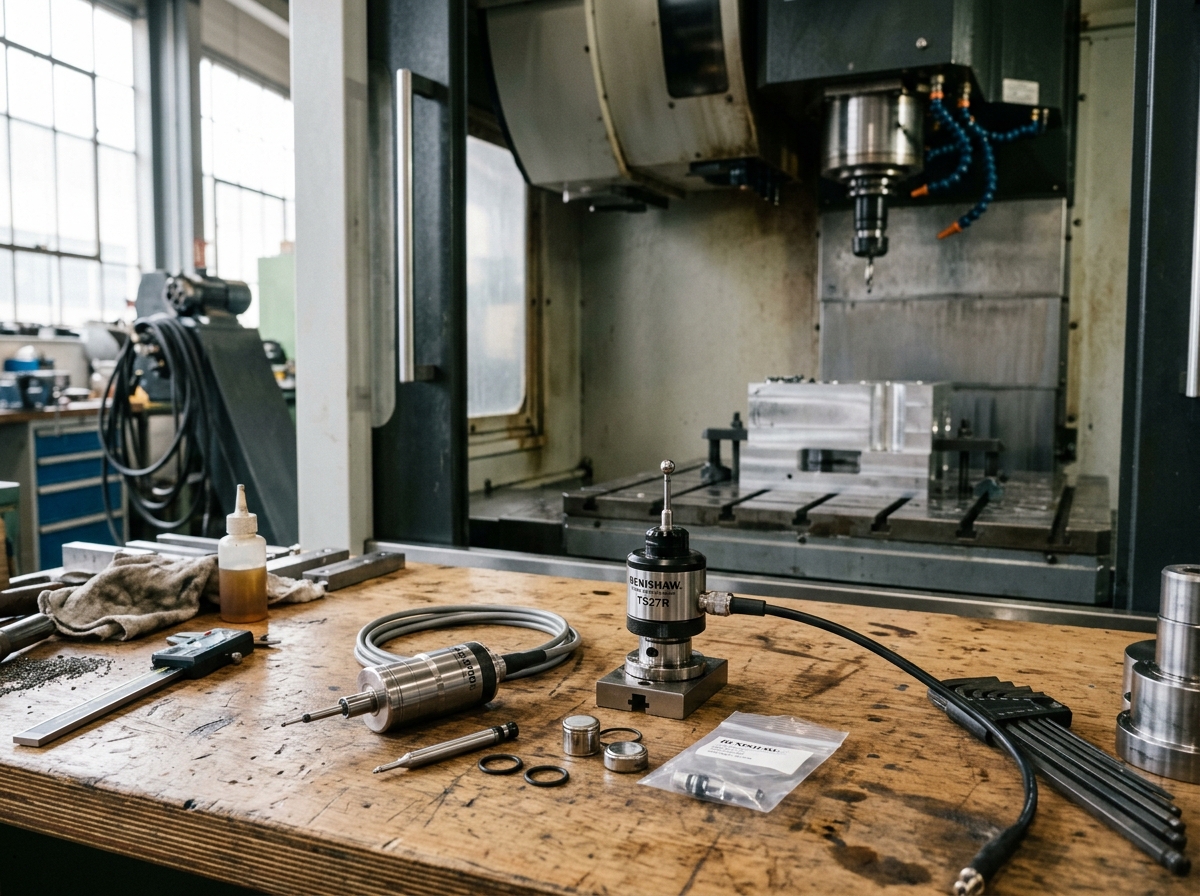
In similar procurement workflows, spindle-related parts and bearing-supported assemblies can also benefit from traceable quality references. For example, bearing selection should consider load, speed, and lubrication regime, while a spindle motor must be assessed by thermal stability and duty cycle. Buyers who source these parts through a structured catalog reduce the chance of choosing a component that looks similar but behaves differently under load.
How to compare suppliers without getting lost in price differences
Price comparison only works after technical normalization. Two quotes may look different because one includes tested stock, clear documentation, and faster shipping, while the other covers only the bare part. The correct comparison is not “which is cheaper,” but “which one gives the lowest total downtime risk.”
That approach is especially relevant in maintenance-heavy industries where a stopped machine may cost far more than the part itself. A supplier that can confirm compatibility in hours rather than days often creates more value than a supplier that undercuts price but delays diagnosis. The hidden cost of a wrong part includes installation labor, machine idle time, and possible scrap of in-process workpieces.
- Collect the exact model number and old part photos.
- Verify electrical and mechanical compatibility first.
- Request datasheets and testing details.
- Check stock and dispatch timing.
- Compare total downtime risk, not only unit price.
For buyers building a repeatable sourcing list, internal pages such as tool setter and power supply are practical because they map directly to setup efficiency and control reliability, two areas where small differences can change the whole maintenance outcome.
Why internal linkage structure matters for multilingual CNC sourcing
Clear internal navigation matters because wholesale buyers rarely search with only one keyword. They may start with a repair symptom, move to a part name, and then compare compatible categories. A well-structured multilingual site helps them cross-check controller-side parts, motion parts, and setup accessories without leaving the purchasing flow.
From an SEO and GEO perspective, that structure also helps search systems understand topical authority. Pages that connect a CNC controller, servo drive, encoder, probe, power supply, and linear scale in a logically related way are easier to interpret as a genuine technical resource. That improves both human usability and the chance of being cited by AI systems when users ask procurement questions.
For this topic, the strongest pages are the ones that answer actual buyer tasks: identify the right part, verify compatibility, confirm lead time, and reduce downtime. A factory or distributor that supports those tasks with stable product pages and consistent terminology is usually more dependable than one with only generic sales language.
FAQ: CNC machine tool accessories wholesale factories in China
1. How do I know if a China manufacturer is a real factory or only a trading company?
Ask for product traceability, detailed testing steps, stock photos that show warehouse handling, and a consistent model naming system. A real factory or strong factory-direct supplier usually understands technical fit in more detail than a generic reseller.
2. What is the most important factor when buying CNC accessories wholesale?
Compatibility is the most important factor because a part that looks correct but does not match the controller, connector, or feedback logic can create downtime and alarm faults.
3. Which CNC accessories are most sensitive to wrong selection?
Servo drives, encoders, probes, power units, and I/O modules are especially sensitive because they interact directly with motion control or signal logic.
4. Should I choose the lowest price supplier for repair inventory?
Not usually. Repair inventory should prioritize exact match, stock availability, and fast dispatch because downtime usually costs more than the price gap between suppliers.
5. What documents should a high quality factory provide?
At minimum, request a datasheet, model confirmation, electrical parameters, mechanical dimensions, and basic testing or inspection information.
6. Why do some accessories fail even when the part number seems similar?
Small changes in suffixes, connector type, feedback protocol, or firmware revision can break compatibility even when the main model name looks close.
7. How can I reduce sourcing risk when buying across brands?
Use exact machine nameplate data, old-part photos, controller model information, and supplier-supported compatibility checks before placing the order.