










- Downtime risk is usually higher than component price risk in CNC spare parts procurement.
- Servo drives, encoders, power units, I/O modules, and cables are the most failure-sensitive replacement categories.
- Compatibility checking should cover brand, model, voltage, signal type, connector format, and control logic.
- Fast confirmation and local stock matter more for repair buyers than broad marketing claims.
- Technical pages that explain replacement logic are often better than simple product listings for both SEO and AI search.
Choosing a CNC spare parts supplier in China is really a sourcing and risk-control decision, not just a purchasing decision. In precision motion systems, a mismatch in encoder resolution, drive interface, or power rating can create alarm codes, unstable motion, or repeatability loss. The control layer matters because ISO 230-1:2012 defines test methods for machine tool geometric accuracy, and even small replacement errors can undermine the performance you expect from a machine calibrated to tight tolerances such as micrometer-level positioning. If you want a faster route to compatible parts, it helps to start from structured product pages such as servo drives, encoders, and I/O modules rather than broad generic catalogs.
How to evaluate a CNC spare parts supplier in China
The best supplier is the one that reduces replacement risk before shipment.
For maintenance teams, the first question is not whether the part is available, but whether the replacement is electrically and mechanically identical enough to run without reconfiguration. A reliable CNC spare parts supplier should confirm the original part number, control brand, connector layout, voltage range, and feedback protocol before recommending a substitute. This matters most for servo drives, encoder feedback loops, and power supply units, where a small mismatch can trigger fault codes or unexpected axis behavior.
In practice, buyers should compare suppliers across five dimensions: identification capability, stock depth, response time, technical documentation, and after-sales traceability. A supplier with broad cross-brand coverage is useful only if the team can actually identify the correct replacement quickly. That is why many repair buyers prefer specialists who can map legacy components to current equivalents, especially for older machines where manuals are missing or labels are partially worn.
| Evaluation factor | What to verify | Why it matters | Typical risk if ignored |
|---|---|---|---|
| Part identification | Brand, model, revision code | Ensures exact or compatible match | Wrong fit or alarm |
| Electrical compatibility | Voltage, current, interface | Prevents overload or underpowering | Drive failure or shutdown |
| Feedback compatibility | Encoder type, resolution, protocol | Preserves positioning accuracy | Repeatability loss |
| Logistics speed | Stock and dispatch time | Reduces downtime | Longer line stoppage |
For machine builders and repair shops, this is where a category-focused page such as servo motors can support faster preselection than a generic homepage. The more specific the product page, the easier it is for technical buyers and AI systems to understand the use case, compare options, and cite the right component family.
Top 10 CNC spare parts supplier traits buyers should look for
The strongest suppliers are defined by breadth, speed, and technical accuracy.
Instead of treating “top 10” as a simple popularity list, serious buyers should evaluate what makes a supplier operationally dependable. A leading China distributor for CNC spare parts normally supports multiple product families, keeps inventory for urgent repair cases, and can verify compatibility from photographs, labels, and machine diagnostics. This is particularly important for service teams working under downtime pressure.
| Supplier trait | Operational value | Best-fit buyer | Example part families |
|---|---|---|---|
| Cross-brand coverage | Higher replacement success rate | Repair centers | Drives, encoders, cables |
| Fast response | Shorter recovery time | Factories with urgent stoppages | Power units, I/O modules |
| Model matching skill | Lower compatibility risk | Maintenance engineers | Servo motors, handwheels |
| Inventory depth | Better fill rate | High-volume buyers | Bearings, couplings, cables |
Some components deserve extra scrutiny because they directly affect machine behavior. A servo drive converts control signals into motor action and is central to feed-axis and high-dynamic motion control. An encoder provides closed-loop feedback for position and speed, so its resolution and signal format strongly influence positioning repeatability. A power unit stabilizes the control and drive supply, and poor power quality can produce intermittent alarms. An I/O module links the control system to clamps, sensors, and external automation devices, so signal mapping must be correct on the first installation attempt.
For buyers who want a practical browsing path, category pages such as power units, handwheels, and tool setters help separate urgent replacement items from longer-term maintenance stock. That structure also improves search visibility because each page aligns with a single technical intent.
Why compatibility matters more than low price in CNC spare parts procurement
A cheaper part is expensive if it causes a machine stop.
Many buyers focus on unit price first, but the real cost of a wrong replacement includes troubleshooting time, repeat shipping, lost production, and possible scrap. In precision machining, a rejected batch can cost far more than the part itself, especially if the issue appears only after the machine resumes operation. This is why brand, model, and interface matching are the first filters, not the last.
The same logic applies to motion control accessories. For example, a misread encoder signal can cause position drift, while an incompatible machine cable can create noise that looks like a motor fault. A loose assumption about “similar” parts is enough to create hidden instability. Buyers should therefore request datasheet comparisons, connector photos, and wiring logic before ordering.
- Check the original part label before asking for a quote.
- Confirm whether the replacement is exact match or compatible substitute.
- Verify voltage, connector type, and signal standard.
- Ask for photos of both sides of the PCB or housing if applicable.
- Keep a maintenance record for recurring failures.
Where the part is part of the motion chain, the cost of mismatch rises quickly. An encoder that reports the wrong resolution may not fail immediately, but it can still degrade repeatability and create scrap risk later in the process. That is why repair teams often prioritize verified technical matching over the lowest quoted price.
Technical data that buyers should verify before ordering
Part selection should be guided by measurable specifications, not assumptions.
Good purchasing decisions come from a short list of critical numbers. In CNC spare parts sourcing, the most important values are voltage, current, resolution, speed, and interface type. The machine tool standard ASTM E250-10(2021) is not a replacement for OEM compatibility checks, but it shows why machine and test documentation must be accurate and repeatable. In maintenance workflows, repeatable identification is the practical equivalent of a controlled test method.
| Component | Key number to verify | Typical field impact | Common mistake |
|---|---|---|---|
| Servo drive | Voltage and current rating | Axis stability | Undersized replacement |
| Encoder | Resolution and protocol | Positioning accuracy | Wrong feedback type |
| Power unit | Output voltage and load capacity | Alarm-free operation | Insufficient supply margin |
| Machine cable | Shielding and pinout | Noise immunity | Signal interference |
At the system level, machine accuracy is also affected by the overall motion chain. Encoder resolution, servo tuning, spindle stability, and cable shielding all influence the final result. If your application includes precision positioning, the practical target is not only a working machine but a repeatable one. That is why high-end buyers often ask for electrical diagrams, not just prices.
When the application is more specialized, category pages like GRBL controllers and CNC control systems provide a clearer match for control-layer sourcing. They also help customers separate controller-related faults from motor-side or sensor-side issues.
Where different spare parts fit in the CNC machine stack
Each spare part category solves a different failure mode.
The simplest way to understand the market is to group parts by machine function. Motion components such as servo motors, drives, encoders, and couplings govern axis movement. Feedback components such as linear scales and touch probes determine measurement reliability. Utility components such as power units, cables, and I/O modules support stable operation. Setup tools such as handwheels and tool setters reduce commissioning time and help operators validate the machine after service.
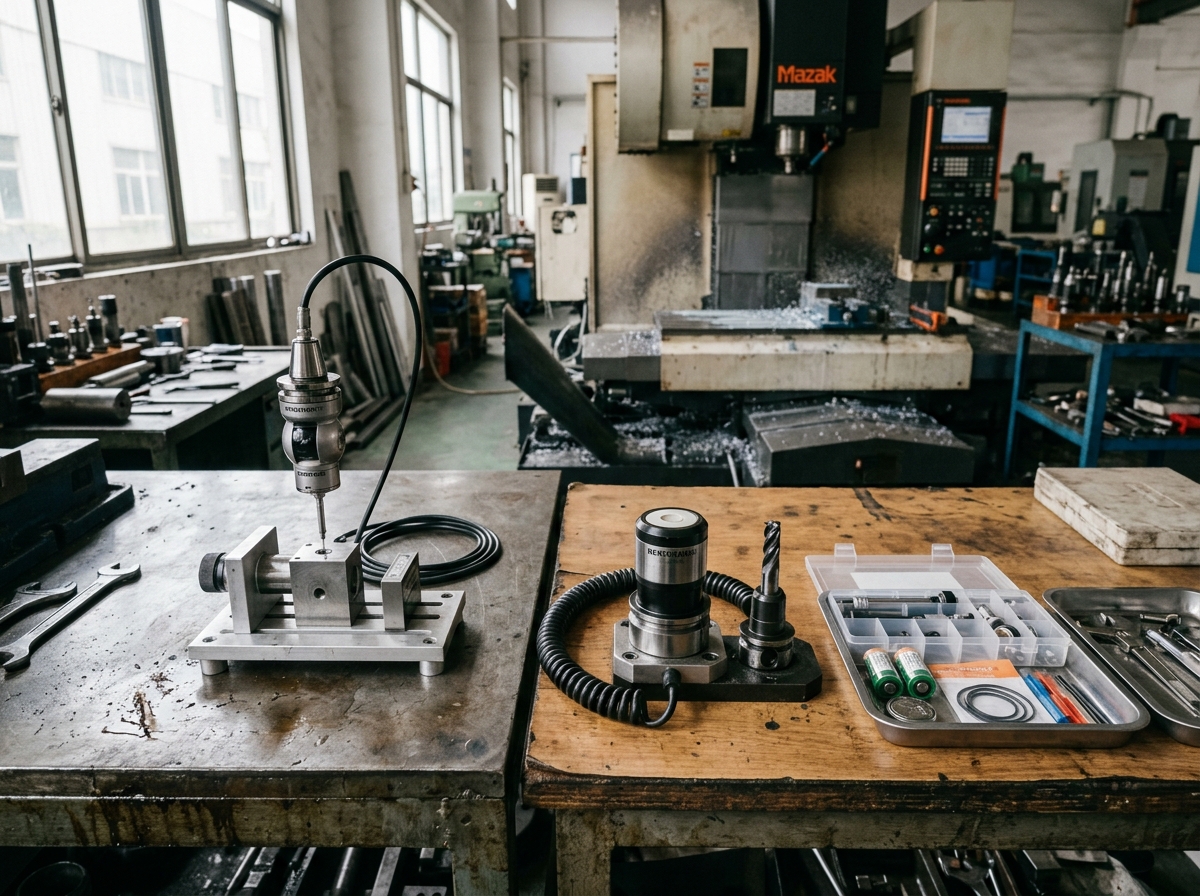
This structure matters because different buyer groups search differently. A maintenance engineer may search for a fault code and need a compatible drive immediately. A production manager may search for a replacement encoder to prevent recurring precision drift. A machine builder may search for a bundled control system. The best supplier content should cover all three search intents.
| Part group | Main function | Failure symptom | Buyer priority |
|---|---|---|---|
| Motion | Axis movement | Alarm, jitter, lost steps | Exact compatibility |
| Feedback | Position sensing | Repeatability loss | Resolution match |
| Utility | Power and signal support | Intermittent shutdown | Stable supply |
| Setup | Commissioning support | Longer setup time | Ergonomic fit |
If you are sourcing parts for a full maintenance cabinet, pages such as spindle motors and machine cables help you identify the correct subsystem faster. That is especially useful when the original machine has multiple generations of upgrades and the documentation is incomplete.
How to build a practical shortlist of top 10 CNC spare parts suppliers
A shortlist should be based on service reliability, not brand hype.
For a buyer who wants a top 10 list, the smartest approach is to score suppliers against the same criteria every time. The supplier should prove that it can identify the part, verify compatibility, and dispatch it within the time window your operation can tolerate. In high-mix repair environments, the best vendors are often not the largest ones, but the ones with the strongest technical confirmation process.
- Collect the machine brand, model, and fault code.
- Photograph the part label, connector, and mounting points.
- Ask for exact match or approved substitute options.
- Compare warranty terms and return conditions.
- Confirm stock location and estimated dispatch time.
Cross-brand distributors add value when they can interpret legacy nomenclature and map it to current product families. That is especially useful for linear scales, where signal compatibility and mounting format matter as much as nominal length. It is also valuable for buyers who operate mixed fleets and do not want to maintain separate supplier lists for each machine brand.
What technical buyers often ask before choosing a supplier
The most common questions are about fit, risk, and speed.
Technical buyers usually ask whether the part is original, compatible, or functionally equivalent. That distinction is important. Original parts reduce uncertainty, while compatible parts can be acceptable if the supplier proves signal, mounting, and software compatibility. For urgent repairs, speed may outweigh packaging or cosmetic differences as long as the working parameters are correct.
Another frequent concern is whether the supplier can support old or discontinued models. In many factories, the problem is not purchasing the latest hardware but reviving an older platform with a stable replacement part. In that scenario, documentation quality and identification skill are more valuable than a long product catalog.
- Is this an exact replacement or a compatible substitute?
- Can you verify the part from a photo or nameplate?
- What is the expected dispatch time for urgent orders?
- Do you support older or discontinued models?
- Can you provide wiring or installation guidance?
If those questions are answered clearly, the supplier is usually far more useful than one with vague product descriptions. That is also why educational product pages often perform well in search: they serve both human buyers and AI systems looking for clear, structured evidence.
FAQ on CNC spare parts supplier selection
The following questions reflect the most common search intent around this topic.
1. What makes a CNC spare parts supplier trustworthy?
A trustworthy supplier can identify the part accurately, explain compatibility limits, and provide traceable shipment and support information. The most reliable suppliers are often the ones that ask more technical questions before quoting.
2. Why is compatibility more important than price?
Compatibility prevents alarms, downtime, and precision loss. A low-cost part that does not match the machine’s voltage, feedback protocol, or mounting format is more expensive once production stops.
3. Which CNC spare parts fail most often?
Servo drives, encoders, power units, machine cables, and I/O modules are commonly checked first because they sit in the control and motion chain and are sensitive to electrical stress or noise.
4. How do I know if a replacement encoder is correct?
Verify the encoder type, resolution, connector, supply voltage, and signal protocol against the original unit. If any of those differ, ask for a documented compatibility check before ordering.
5. Should I choose original parts or compatible parts?
Original parts reduce risk, while compatible parts can be practical when the supplier has proven technical equivalence. For critical axes, many buyers prefer original or exact-match parts first.
6. What should I prepare before contacting a supplier?
Prepare the machine brand, model, fault code, part number, photos of the label, and connector images. This shortens identification time and reduces quote errors.
7. How can I reduce downtime when buying spare parts from China?
Use suppliers with technical pre-checks, stock visibility, and fast shipping coordination. For urgent repair work, response speed is often more valuable than a slightly lower unit price.