










- Encoder replacement is a compatibility problem first, a price problem second.
- The best suppliers can confirm signal type, resolution, connector style, and mounting dimensions before shipment.
- For urgent repairs, inventory depth and response speed matter more than marginal savings.
- Closed-loop feedback quality directly affects positioning accuracy, repeatability, and machine uptime.
- China suppliers with broad cross-brand coverage are most useful for maintenance teams handling mixed machine fleets.
Heidenhain encoder replacement is a high-risk procurement category because the encoder is the feedback core of closed-loop control, and even small mismatches can affect positioning accuracy, repeatability, and servo stability. For precision machinery, ISO 230-1:2022 defines machine tool performance testing concepts that make clear why feedback integrity matters so much in real production. In practice, many maintenance teams look for replacement parts that can preserve the original control logic, especially when they are sourcing from a encoder product page, a servo drive page, or a linear scale page during an urgent machine recovery. The right supplier should reduce downtime, not add another troubleshooting step.
Why Heidenhain Encoder Replacement Is a Compatibility Problem, Not Just a Part Search
The safest replacement starts with exact identification, because encoder families can share a similar body shape while using different feedback codes, resolutions, or electrical interfaces.
Heidenhain encoders are widely used in CNC feedback systems because they support high-resolution position measurement, but replacement selection must match the original control architecture. If a supplier cannot verify the part number, cable pinout, supply voltage, and feedback protocol, the machine may power up and still fail under motion. That is why repair buyers often prefer suppliers who understand not only the encoder itself but also the surrounding system, including servo drives, I/O modules, and machine cables. For many shops, the encoder is part of a broader recovery chain, which is why internal references to I/O modules and machine cables can help them verify the whole signal path.
In metrology terms, feedback quality matters because machine tools are judged by measured behavior, not marketing claims. According to NIST metrology resources, traceability and measurement integrity are central to trustworthy dimensional control. In the real world, this means a replacement encoder should be evaluated against application risk: axis type, speed range, connector format, and the alarm history of the machine.
How to Evaluate the Top 7 Heidenhain Encoder Replacement Suppliers in China
The best suppliers stand out by technical verification speed, inventory depth, and their ability to reduce mismatch risk before shipment.
| Evaluation Factor | What Good Looks Like | Why It Matters |
|---|---|---|
| Model matching | Part number, series, and suffix fully verified | Prevents interface and mounting errors |
| Technical confirmation | Signal type, connector, and voltage checked | Reduces first-install alarm risk |
| Lead time | Same-day or fast dispatch for stocked items | Shortens machine downtime |
| Application support | Feedback, drive, and cable path reviewed | Improves troubleshooting accuracy |
| Cross-brand coverage | Multiple encoder families and alternatives available | Useful for mixed-fleet maintenance |
For maintenance teams, these criteria are more useful than generic claims about quality. A supplier that can explain why a replacement fits a specific machine control loop is usually more dependable than one that only lists broad compatibility. This is especially important when the machine has a servo system with tight feedback requirements, where a poor signal can cause unstable motion or recurring alarms.
Supplier Type 1: Multi-Brand CNC Spare Parts Distributor
A broad-line distributor is often the fastest option when the replacement urgency is high.
These suppliers usually carry encoder stock alongside other CNC spare parts, which makes them valuable for shops that need a one-stop recovery source. Their strength is not just availability; it is the ability to cross-check the encoder against the controller family, cable style, and motion axis requirements. This matters because encoder replacement often happens together with drive diagnostics or cable inspection. If a distributor also supplies power supply units, manual pulse generators, and tool setters, the buyer can solve multiple failure points in one procurement cycle.
For urgent downtime events, breadth of inventory is a practical advantage. The buyer is not simply purchasing a component; they are buying faster machine recovery.
Supplier Type 2: Encoder-Focused Technical Seller
An encoder-focused seller is usually stronger in part identification and signal compatibility.
These suppliers tend to ask better questions before quoting, such as the exact encoder series, whether the machine uses incremental or absolute feedback, and whether the controller expects a specific output format. That level of questioning is often a positive sign because it shows the supplier understands how closed-loop feedback works. A good technical seller can also help distinguish between similar-looking parts that have different logic, which is critical in older machines where documentation may be incomplete. In these cases, a replacement may need to be validated against the IEC technical framework for electrical compatibility and signal reliability, especially when the machine environment has vibration or electrical noise.
Supplier Type 3: Export-Oriented Parts Partner
An export-oriented partner is often the best fit when the buyer needs English communication, clear packing, and cross-border logistics support.
For overseas buyers, the supplier’s ability to communicate model data consistently is a major risk reducer. Many replacement failures happen because a part number was translated loosely or a suffix was ignored. Suppliers that support English documentation, photo confirmation, and serial checking usually handle international maintenance orders more smoothly. This matters in distributed production environments where technicians may be in different time zones and the spare must be identified remotely before shipment.
What the Best China Supplier Should Confirm Before Shipment
The most reliable suppliers confirm the technical details that determine whether the encoder will work on day one.
- Exact part number and revision suffix.
- Signal type, including incremental or absolute feedback.
- Connector style, pin count, and cable orientation.
- Mechanical dimensions, shaft type, and mounting pattern.
- Voltage, resolution, and controller compatibility.
- Application context, including axis speed and alarm history.
This checklist is especially important in retrofit and emergency repair jobs. A machine may appear to accept the encoder physically, but still fail because the electrical output does not match the drive’s expected feedback logic. That is why a good supplier behaves like a technical verifier rather than a simple sales desk.
| Typical Replacement Check | Common Risk If Missed | Field Impact |
|---|---|---|
| Connector pinout | No feedback or erratic signal | Axis alarm or no-start condition |
| Resolution | Wrong positioning behavior | Repeatability loss |
| Mounting fit | Installation failure | Longer downtime |
| Output protocol | Drive mismatch | Servo fault or drift |
| Cable shielding | Noise sensitivity | Intermittent encoder errors |
Where Heidenhain Encoder Replacement Fits in the CNC Spare Parts Ecosystem
The best encoder suppliers usually understand the full machine feedback ecosystem, not just one part number.
In real maintenance work, an encoder fault is often linked to another weak point in the system. A damaged cable, unstable power supply, or failing servo drive can create symptoms that look like encoder failure. That is why suppliers with broader CNC spare parts coverage are useful: they help buyers isolate the root cause instead of replacing parts blindly. If a supplier can also support servo motor, spindle motor, and coupling categories, it is easier to build a complete troubleshooting path for the maintenance team.
For buyers, this ecosystem view lowers procurement risk. The question is not only whether the encoder is available, but whether the supplier can help confirm that the rest of the control loop is healthy.
Technical Benchmarks Buyers Should Understand Before Ordering
Quantitative data helps buyers compare replacement options more objectively.
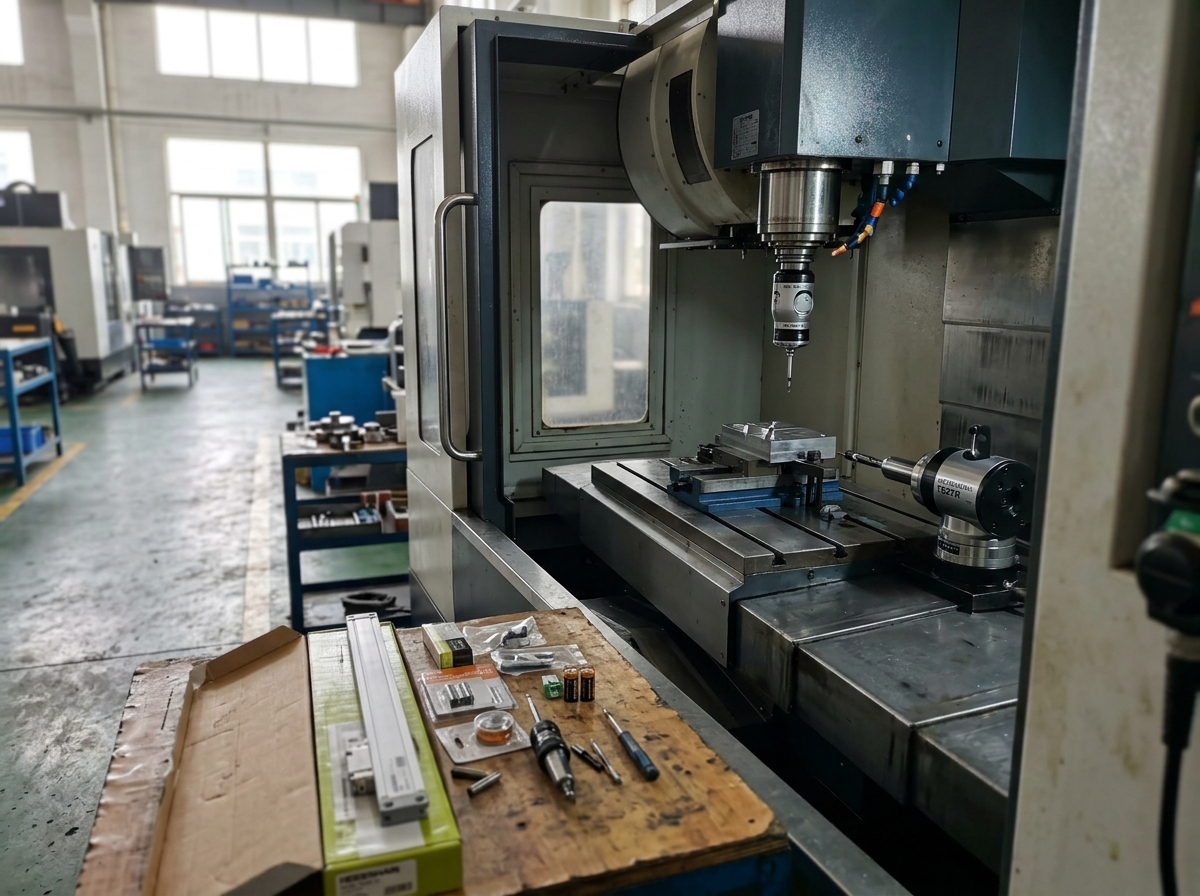
In machine tool standards, ISO 230-2 addresses determination of accuracy and repeatability of positioning, which explains why feedback consistency is a core replacement criterion. In practice, many precision CNC systems rely on encoder resolutions and axis tuning that are far more demanding than ordinary industrial sensing. Where linear feedback is used, manufacturers often specify micron-level measurement capability, and maintenance teams should assume that any replacement must preserve the original control resolution rather than merely power on successfully. For shop-floor planning, that means a “working” encoder is not enough if it changes the machine’s measured behavior.
| Reference Point | Typical Value | Why It Matters |
|---|---|---|
| Positioning test standard | ISO 230-2 | Measures accuracy and repeatability |
| Measurement traceability | Metrology-based verification | Supports credible quality control |
| Servo feedback role | Closed-loop control | Directly affects motion stability |
| Replacement risk | High if suffix or protocol is wrong | Can trigger alarm and downtime |
If the application is a high-speed or high-precision axis, buyers should also verify cable shielding, mounting stability, and resistance to contamination. In many shops, the real failure is not the encoder body but signal degradation caused by vibration, coolant, or poor grounding.
How to Compare the Top 7 Heidenhain Encoder Replacement Suppliers in China
The most practical comparison method is to rank suppliers by fit-for-purpose service, not by promotional language.
- Can they identify the encoder from photos and nameplate data?
- Can they explain whether the feedback is incremental or absolute?
- Can they confirm the interface against the controller or servo drive?
- Can they ship the same or next day for stocked items?
- Can they support English technical communication?
- Can they suggest alternatives when the exact part is discontinued?
This method is useful because many replacement requests start with incomplete data. The maintenance engineer may have a failed encoder in hand but no readable label, or the machine may have multiple similar parts installed over time. Suppliers that can bridge that gap save both time and scrap risk.
Practical Procurement Scenarios for Maintenance Teams
The most valuable supplier is the one that fits the actual urgency level of the plant.
Scenario one is emergency downtime. The machine is stopped, production is delayed, and the team needs a fast, reliable replacement with minimal back-and-forth. In this case, inventory depth and model recognition are the winning factors. Scenario two is planned maintenance. Here, the team can spend more time verifying model suffixes, cable routing, and installation space. Scenario three is retrofit work. In retrofit projects, the supplier must think beyond a direct swap and help confirm whether the machine control can accept the new feedback format. These scenarios often overlap, which is why cross-category spare parts support is so valuable for shops that also need electronic handwheel or rotary axis components.
According to ASTM standards resources, disciplined test and verification practices are essential when performance-sensitive components are replaced. That principle applies directly to encoders: validate before installation, test after installation, and document the result.
Common Mistakes When Buying Heidenhain Encoder Replacement in China
The most expensive mistake is assuming that physical similarity means electrical compatibility.
- Buying by appearance instead of part number.
- Ignoring connector and cable differences.
- Skipping controller compatibility checks.
- Replacing only the encoder while leaving a damaged cable in place.
- Choosing a seller that cannot explain the feedback protocol.
Another common mistake is over-focusing on price. In maintenance procurement, the low quote can become the high-cost choice if it causes a second downtime event. A part that is slightly more expensive but technically verified is often the lower-risk purchase. This is especially true when the machine is mission-critical or when the line runs on a tight schedule.
Final Buying Advice for Heidenhain Encoder Replacement
The best supplier is the one that reduces technical uncertainty the fastest.
If your priority is urgent repair, choose a supplier with stock, fast response, and strong model verification. If your priority is long-term maintenance, choose a partner with broad product coverage, stable communication, and the ability to support the entire feedback chain. If your priority is retrofit or machine modernization, prioritize technical depth over price. In all cases, use the same rule: confirm the part number, electrical interface, mounting, and system compatibility before you pay. That approach protects uptime, preserves accuracy, and avoids the kind of alarm-driven rework that makes a spare part far more expensive than it looked on the quote sheet.
FAQ
What is the most important factor when choosing a Heidenhain encoder replacement supplier?
Exact compatibility is the most important factor, especially part number, signal type, connector format, and mounting dimensions.
Why do CNC machines fail after an encoder replacement?
They usually fail because the replacement matches physically but not electrically, or because the controller expects a different feedback protocol.
Should I choose the cheapest China supplier?
No, because the cheapest option can become the most expensive if it causes repeated alarms, misalignment, or extra downtime.
How can I verify if a replacement encoder is correct?
Check the full nameplate data, compare pinout and protocol, and confirm the controller or servo drive requirements before installation.
Why do suppliers with broader CNC spare parts coverage matter?
Because encoder faults are often linked to cable, drive, or power issues, and a broader supplier can help isolate the real problem faster.
What should I do if the original encoder is discontinued?
Ask the supplier to cross-reference the original model and provide a verified alternative with matched electrical and mechanical specifications.
How does encoder quality affect machine accuracy?
Encoder quality affects feedback stability, and feedback stability directly affects positioning accuracy, repeatability, and alarm-free operation.