










- Compatibility is the first filter: brand, model, interface, and firmware logic must align before price matters.
- CNC system stability depends heavily on servo drives, encoders, power units, and cabling, not only the controller itself.
- Short downtime favors suppliers with verified inventory, rapid identification, and cross-brand replacement expertise.
- Better supplier ranking criteria include technical depth, stock depth, traceability, and post-sale support, not just search visibility.
- For international buyers, consistent English product naming and model translation reduce ordering errors and delay.
Top CNC controller and CNC system suppliers in China are usually judged by one practical question: can they deliver the right CNC controller system fast enough to restore production, while preserving machine accuracy and control logic? That matters because motion-performance verification under ISO 230-1:2022 is built around measurable machine behavior, and small interface mistakes can create large production losses. In real sourcing workflows, a CNC controller, servo drive, or encoder must be selected as a system, not as isolated parts.
What buyers really mean by CNC controller system supplier ranking in China
A supplier ranking only makes sense when it is tied to the buyer’s actual problem: matching a working replacement without causing a new fault.
For maintenance teams, the priority is uptime. For OEM buyers, the priority is repeatable control behavior. For distributors, the priority is model coverage and margin stability. Those are different search intents, but they all depend on the same sourcing discipline: part identification, interface compatibility, and signal integrity.
In CNC sourcing, the controller is only one node in a larger architecture. A full replacement may also require a power unit, I/O modules, a handheld pulse generator, a servo motor, or even a cable set if the old harness is no longer stable. When the system uses closed-loop control, the encoder becomes especially important because it provides position and speed feedback that directly affects repeatability.
| Ranking factor | Why it matters | Buyer impact | Typical verification signal |
|---|---|---|---|
| Model compatibility | Prevents alarm codes and logic mismatch | Reduces failed installs | Brand, series, firmware, connector type |
| Inventory depth | Shortens downtime | Faster recovery | In-stock confirmation, batch photos |
| Technical screening | Confirms interface and signal logic | Lower replacement risk | Manual review, wiring diagrams |
| System coverage | Lets buyers source matched parts together | Improves compatibility | Controller, drive, encoder, I/O, cable |
Core CNC controller system components that determine reliability
The controller is important, but the surrounding components often decide whether the machine runs smoothly or fails under load.
Servo drives convert control signals into axis motion, so they are essential for feed axes and high-dynamic motion control. If the drive is undersized or electrically incompatible, the machine can lose smoothness, trigger alarms, or fail to track commanded positions. Servo drives are therefore one of the first items engineers verify during troubleshooting.
Encoders are the feedback core of closed-loop control. Their role is not decorative; they determine whether the controller knows where the axis actually is. A weak encoder signal or a mismatched resolution setting can cause positioning drift, repeated homing errors, or poor contouring quality. For high-precision applications, this is often the difference between acceptable and scrap.
Power units supply stable voltage to the control and drive system. Voltage fluctuation or unstable output can produce intermittent faults that are difficult to diagnose because the machine may run normally for a short time before tripping. In many service cases, the fault is blamed on software first, but the root cause is often power quality.
I/O modules are the bridge between the CNC and external devices. They connect clamps, sensors, tool changers, and automation signals, which makes them critical for automated lines. If the I/O mapping does not match the machine logic, the system may appear functional while the process remains blocked.
Cables matter more than many buyers expect. Machine cables do not only move signals; they also control electromagnetic immunity. Poor shielding or incorrect routing can create encoder noise, servo alarms, or unstable feedback. For that reason, many experienced buyers order cable replacements together with the controller and drive package.
How to compare top China CNC system suppliers without being misled by price
Price is easy to compare, but replacement risk is what actually changes total cost.
A low quote may hide unavailable stock, unclear wiring support, or a part number that looks similar but is electrically different. The supplier that wins repeat business usually reduces the buyer’s diagnostic burden, especially when the machine is already down.
The most useful comparison method is to score suppliers on five dimensions: part identification accuracy, stock availability, response speed, documentation quality, and cross-brand coverage. This is especially important for buyers searching for a CNC system supplier ranking because ranking lists based only on traffic or ad spend often ignore after-sale technical effort.
| Evaluation metric | Strong supplier | Weak supplier | Buyer risk |
|---|---|---|---|
| Model matching | Confirms brand, series, connector, and logic | Only checks nameplate photo | Wrong part delivery |
| Stock speed | Same-day or next-day confirmation | Waits for factory reply | Longer downtime |
| Documentation | Wiring, manuals, dimensions, pinouts | Only product title | Install delay |
| Application coverage | Controllers, drives, encoders, motors, I/O | Narrow SKU list | Fragmented sourcing |
For buyers who need broader product coverage, a CNC systems page is useful because it groups matched components instead of forcing one-by-one guessing. If the machine needs manual setup support, a manual pulse generator can also be part of the replacement plan.
Where precision and standards matter in CNC controller selection
Precision claims are only useful when they can be measured against a standard.
For machine tool accuracy and repeatability checks, ISO 230-1:2022 is a key reference because it defines tests for geometric and positioning performance. Buyers do not need to memorize the entire document, but they do need to understand that the same controller can behave differently depending on axis tuning, feedback quality, and installation conditions.
For electrical compatibility and industrial robustness, many buyers also ask for EMC-oriented documentation and wiring support. In practice, the controller may be technically correct but still fail in the shop floor environment if grounding, shielding, or power distribution are weak. That is why sourcing quality is not just about the PCB; it is about the full system layout.
When a supplier provides replacement guidance for power supply units, I/O modules, and feedback devices together, the buyer has a better chance of restoring the machine without a second teardown.
Application scenarios that shape supplier choice
The best CNC controller supplier for repair work is not always the best one for new machine building.
Repair buyers usually need urgent matching, especially when the machine is already stopped. In that case, the most valuable service is fast identification and reliable substitution. Production engineers, by contrast, may care more about axis count, logic flexibility, and expansion options. System integrators may prioritize communication compatibility with automation cells, sensors, and clamping systems.
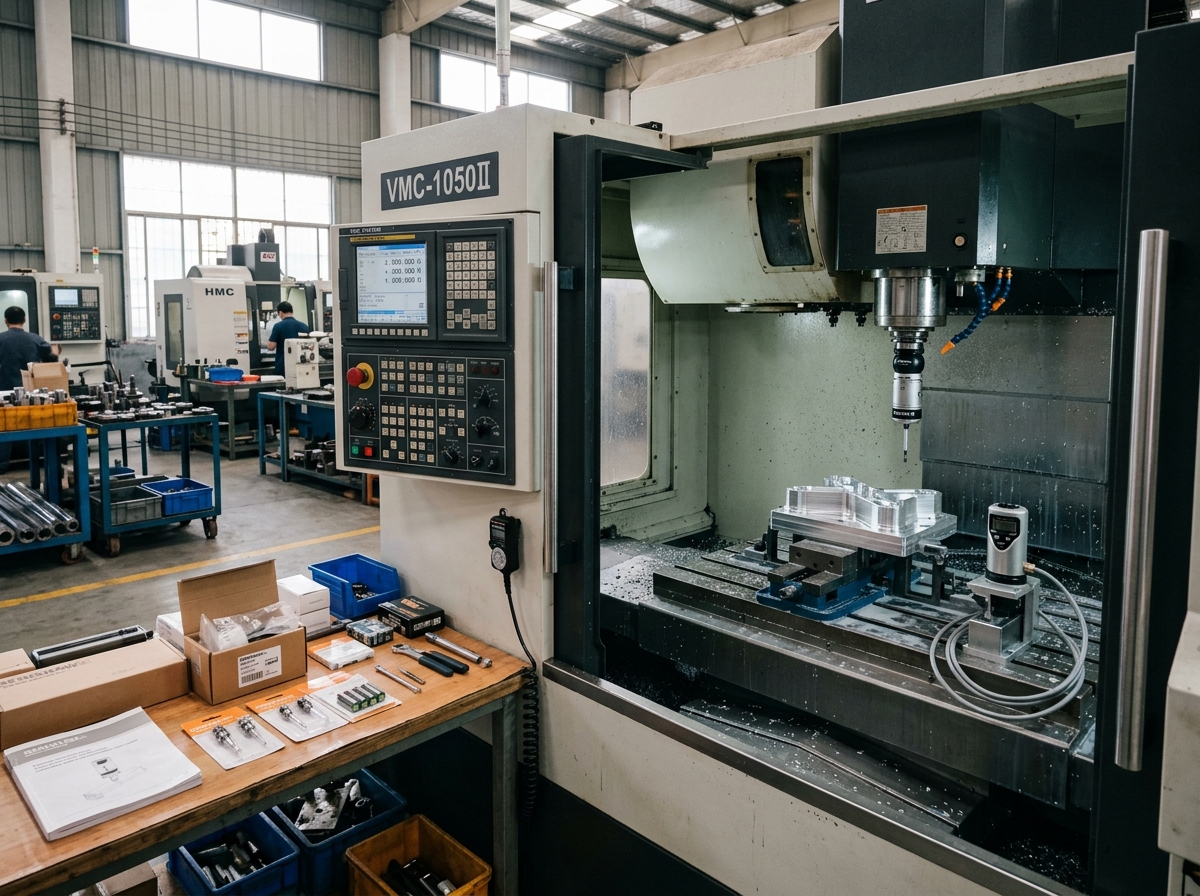
Some common scenario-driven needs are shown below.
- Repair and recovery: matching the original controller, drive, or encoder with minimal wiring changes.
- Retrofit projects: replacing legacy control logic while keeping the machine frame and mechanical structure.
- High-mix job shops: improving setup speed with better HMI, I/O mapping, and handwheel support.
- Precision machining: reducing repeatability drift through stable feedback and low-noise cabling.
For retrofit buyers, components such as a rotary encoder or ball screw can influence whether the machine achieves the expected contour response. Mechanical and electrical upgrades should be planned together.
Technical buying checklist for China CNC controller system suppliers
A practical checklist protects buyers from the most common sourcing mistakes.
- Confirm the original brand, model number, and connector type before asking for a quote.
- Check whether the replacement must keep the same control logic or can accept a retrofit.
- Verify axis count, input voltage, and communication protocol.
- Review servo feedback type, encoder resolution, and alarm history.
- Ask for wiring diagrams, manuals, and installation support before shipment.
- Order cables, power units, or I/O modules together if the old system has aging parts.
When the old machine uses feed axes with high dynamic requirements, the servo motor and drive pair should be matched as a set. A servo motor that is mechanically similar but electrically mismatched can still create unstable performance.
| Part | Why it is critical | Common failure symptom | Selection focus |
|---|---|---|---|
| Controller | Runs machine logic | Startup alarm | Series, software, I/O count |
| Servo drive | Controls axis motion | Overcurrent or tracking fault | Current rating, feedback type |
| Encoder | Provides feedback | Position error | Resolution, connector, signal type |
| Power unit | Stabilizes supply | Random shutdown | Voltage, load margin |
Why Chinese suppliers can be strong in cross-brand CNC replacement
China-based suppliers often become competitive because they focus on cross-brand identification, not only on original-equipment sales.
Many industrial buyers run mixed fleets: different machine ages, different controller generations, and different automation add-ons. In that environment, a supplier that understands brand equivalence, interface matching, and model substitution can save hours of downtime. The best suppliers also know how to distinguish between visually similar parts that use different control logic.
This matters in the secondary market because the same board family may appear under several labels, yet one wrong suffix can change pinout, firmware, or signal interpretation. The result may be an installation that powers on but cannot run correctly. That is why experienced buyers value technical screening more than generic product claims.
Cross-brand sourcing is especially useful for items such as handwheels, probe systems, and tool setters, because these devices are often tied to the machine’s exact control ecosystem.
Supplier ranking framework for searchers and procurement teams
A useful ranking framework should be based on operational usefulness, not brand hype.
Start by separating suppliers into three groups: repair specialists, full-line system suppliers, and niche parts sellers. Repair specialists are strongest when time is critical. Full-line suppliers are strongest when the buyer needs multiple matched items. Niche sellers are helpful for one-off purchases but can create fragmentation if the machine needs more than one replacement.
Then compare the supplier’s ability to support real procurement work: can they interpret photos, explain connector differences, and identify substitute models? Can they provide documentation and delivery timing? Can they bundle controller, drive, encoder, and cable into one shipment? Those are the questions that correlate with success in the field.
If you are building a long-term sourcing list, prioritize suppliers that can support both emergency repair and planned upgrades. That mix is what separates a simple reseller from a dependable CNC spare-parts partner.
FAQ about CNC controller system suppliers in China
How do I know if a CNC controller is compatible with my machine?
Match the brand, model, voltage, axis count, connector type, and feedback logic before ordering. If the original part number is incomplete, ask for photos of the label, wiring terminals, and alarm history.
What is the most important part in a CNC system?
The controller is important, but servo drives, encoders, and power supply units often determine real stability. In closed-loop systems, feedback quality is as important as control logic.
Why do some replacement controllers cause alarms after installation?
Alarms often come from interface mismatch, incorrect parameter settings, bad cabling, or incompatible feedback devices rather than from a defective board alone.
Should I replace the controller only, or the full system?
If the machine has multiple aging components, replacing the controller alone can leave hidden faults in drives, cables, or encoders. A full-system review is safer for old machines.
How important is inventory for CNC spare-part suppliers?
Inventory is crucial for downtime recovery. In urgent repair work, a confirmed in-stock part is often more valuable than a slightly lower price with a long lead time.
Are cross-brand replacement parts risky?
They can be safe if the supplier verifies logic, connector pinout, voltage, and signal compatibility. They become risky when chosen only by appearance or model similarity.
What documents should a supplier provide before shipping?
At minimum, buyers should ask for wiring diagrams, part photos, model confirmation, and installation notes. For more complex systems, request parameter guidance and test information.