










- The servo amplifier translates CNC motion commands into controlled motor power for accurate axis movement.
- Closed-loop feedback from the encoder is what lets the system correct position and speed errors in real time.
- Compatibility matters more than price: model family, encoder type, voltage class, and connector logic must match.
- Power quality, cable shielding, and grounding can trigger alarms even when the amplifier itself is healthy.
- For replacement purchases, the fastest path is to verify nameplate data, alarm code history, and interface revision before ordering.
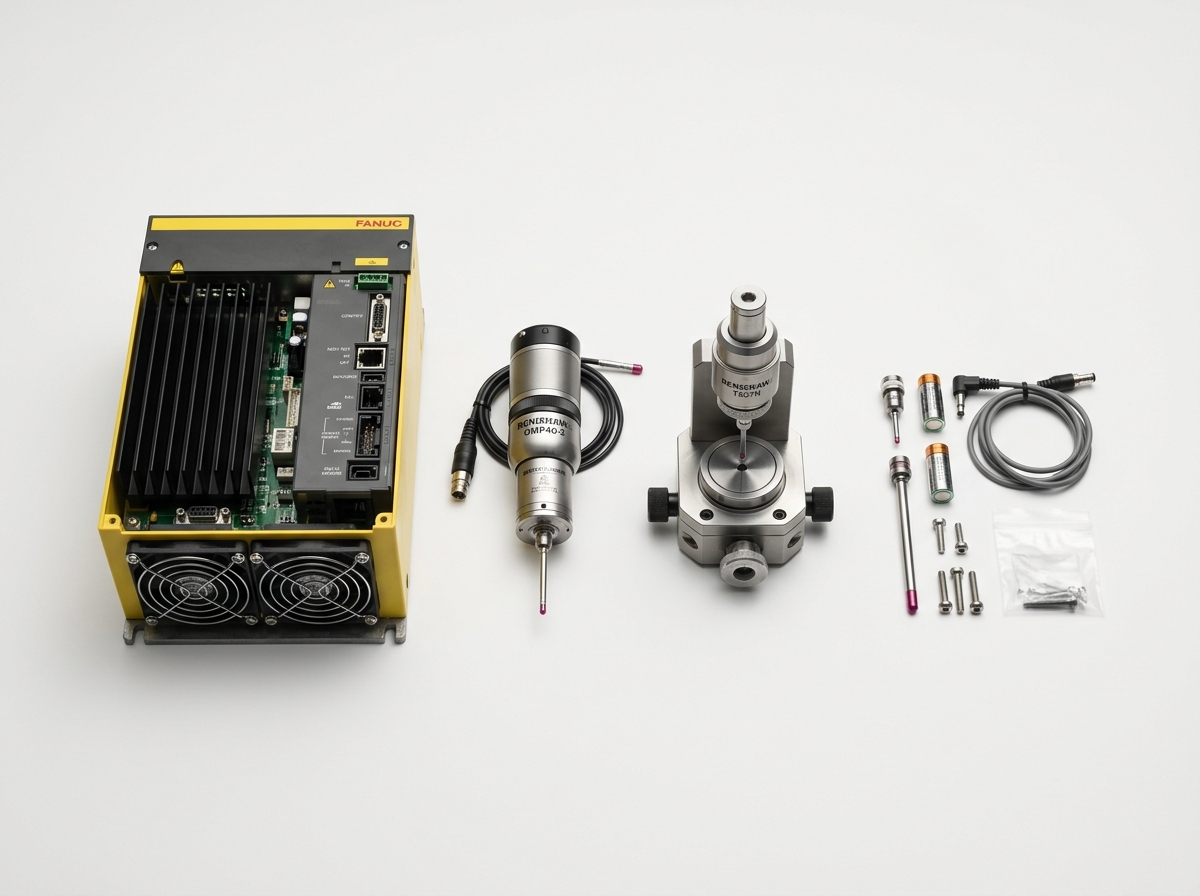
Fanuc servo amplifier troubleshooting sits at the center of CNC motion control because the amplifier is the final conversion point between digital commands and physical axis movement. In closed-loop machining, positioning accuracy is often discussed in micrometers rather than millimeters, and standards such as ISO 230-1 define machine-tool positioning test methods that rely on repeatable motion behavior. On the feedback side, encoder resolution and signal integrity are just as important as the power stage, which is why grounding, shielding, and connector compatibility must be checked before a replacement is installed. For buyers sourcing replacement parts, the right product page matters too: see the servo drives, servo motors, and encoders categories when matching a drive to the rest of the axis chain.
Fanuc Servo Amplifier Working Principle in CNC Motion Control
The core principle is command amplification with feedback correction. A CNC controller issues a motion reference, usually in the form of pulse trains, velocity commands, or digital bus data depending on the system generation, and the servo amplifier turns that reference into controlled motor current. Current is the direct variable that creates torque in a servo motor, so the amplifier’s first job is to regulate current quickly and accurately.
That process usually happens in layered control loops. The inner current loop reacts fastest, the velocity loop filters motion, and the position loop closes the path between the commanded target and the actual axis location. This is why servo drive control can hold smooth motion even during rapid acceleration, light load changes, or direction reversals. In a CNC machine, those loops are what keep the axis from hunting, lagging, or overshooting.
From a sourcing perspective, the amplifier also behaves like a translator. It must understand the controller’s command format, power the motor within the correct voltage class, and read feedback from the correct encoder style. When these elements do not align, the axis may still power up, but the machine may produce alarms, weak torque, or drift under load. That is why replacement planning should begin with the exact part number, not just the machine model.
| Control layer | Main job | Typical effect on motion | What can go wrong |
|---|---|---|---|
| Current loop | Regulates motor torque | Fast response | Overcurrent, heat, torque ripple |
| Velocity loop | Stabilizes speed | Smoother cutting feed | Speed hunting, chatter |
| Position loop | Tracks commanded location | High contour accuracy | Following error, overshoot |
How the Servo Amplifier Converts CNC Commands into Axis Motion
The servo amplifier converts small control signals into high-energy motor drive output through power electronics and pulse-width modulation. Internally, an inverter stage switches DC bus power at high frequency to synthesize a three-phase waveform that the motor can use. The result is not a simple on-off output; it is a continuously adjusted waveform designed to control torque with precision.
In a typical Fanuc servo amplifier chain, the control board reads the command, the feedback section compares actual motion to target motion, and the power stage adjusts output accordingly. If the axis needs more torque, the amplifier increases current. If the axis reaches the target or the load drops, the amplifier reduces output. This real-time correction is what makes CNC motion control repeatable enough for fine finishing, hole positioning, and multi-axis interpolation.
Because the amplifier is dealing with switching power, thermal design matters. Semiconductor loss and heat sink performance determine how long the drive can sustain load without derating. In industrial servo systems, the cooling path is as important as the electronics path, especially on machines running long cycle times or aggressive acceleration profiles. A replacement part that fits electrically but not thermally can create intermittent alarms after only a few minutes of operation.
For practical machine maintenance, the difference between a weak amplifier and a healthy one often appears first as a behavior change, not a total failure. The machine may still home, but acceleration becomes uneven. It may finish light cuts but fail during rapids. It may pass at idle, then alarm once the spindle and coolant systems raise cabinet temperature. Those symptoms point to the amplifier, the feedback loop, or the power supply chain rather than the mechanical axis alone.
Why Encoder Feedback Determines Servo Drive Control Accuracy
Encoder feedback is the closed-loop reference that tells the amplifier where the motor really is. Without that feedback, the drive cannot compare command and actual position, and the system loses the self-correcting behavior that defines servo drive control. In practice, encoder quality affects positioning repeatability, speed stability, and the ability to recover from load disturbance.
For many CNC users, the encoder is the hidden half of the system. The amplifier may be the visible failure point, but an intermittent encoder signal can produce the same alarms. Signal loss, contamination, bent pins, incorrect cable shielding, or incompatible resolution can all cause following errors or axis miscounts. That is why a repair decision should treat encoder, cable, and amplifier as one motion chain.
One useful benchmark comes from machine-tool test practice rather than marketing claims. ISO 230-1 defines methods for testing circular and linear positioning performance, which gives buyers a framework for thinking about repeatability instead of only looking at nominal motor ratings. In a real shop, that matters because a 0.01 mm drift in a critical bore or fit surface can be more expensive than the price difference between two replacement drives.
| Feedback item | What it affects | Common failure sign | Replacement risk if mismatched |
|---|---|---|---|
| Encoder resolution | Position granularity | Position error alarm | Medium to high |
| Signal shielding | Noise immunity | Intermittent alarm | High |
| Connector pinout | Communication integrity | No feedback detected | High |
| Voltage level | Signal compatibility | Startup fault | High |
Common Servo Amplifier Signals, Ratings, and Matching Rules
Matching rules matter because a servo amplifier is not a generic power module. It must match voltage class, current rating, encoder type, and controller generation. In many industrial systems, the nameplate is the first source of truth, but the alarm history and connector layout are often just as important when the label is worn or the part has been repaired before.
A useful replacement checklist is to verify three levels: electrical, communication, and mechanical interface. Electrical matching includes input voltage, output current, and regenerative capacity. Communication matching includes command format, feedback type, and any digital bus revision. Mechanical matching includes mounting footprint, connector orientation, and cabinet clearance. Missing any one of those can turn a fast replacement into a new downtime event.
The following comparison shows the practical differences buyers usually weigh when deciding whether a servo amplifier can be reused, repaired, or replaced. The numbers are representative engineering checks, while actual values must always come from the machine documentation or nameplate.
| Check item | What to verify | Typical value type | Why it matters |
|---|---|---|---|
| Input class | Voltage and phase | 200 V or 400 V class | Affects power compatibility |
| Output current | Continuous and peak current | Ampere rating | Affects torque capacity |
| Feedback type | Encoder or resolver family | Digital or analog feedback | Affects closed-loop control |
| Protection logic | Alarm and interlock behavior | Fault code family | Affects startup and diagnosis |
For buyers building a spare-parts strategy, this is where a structured catalog helps. If you need to compare controller-side components as well, the CNC control panels and power supplies pages are useful because a servo fault is sometimes caused by upstream instability rather than the drive itself. If the machine uses multiple motion axes, the CNC accessories page can help identify related cables, terminals, and interface parts that affect system reliability.
Fanuc Servo Amplifier Faults: What the Alarm Is Really Telling You
An amplifier alarm is usually a symptom, not a diagnosis. The code tells you where the protection logic detected a problem, but not always the original cause. Overcurrent can be caused by a mechanical bind, a shorted motor winding, a damaged cable, or an internal power-stage fault. Position alarms can result from encoder noise, missed pulses, or loose connectors. Overvoltage may point to regenerative energy that the drive cannot absorb quickly enough.
In maintenance practice, the fastest way to separate amplifier failure from system failure is to isolate the axis chain. Check whether the alarm follows the amplifier, the motor, or the cable. If the alarm disappears when the motor cable is replaced, the amplifier may be healthy. If the alarm stays with the drive, the power stage or control board is more likely at fault. This is why repair technicians often test components as a set rather than one by one.
Power quality also matters more than many buyers expect. A servo amplifier depends on stable cabinet supply, correct grounding, and low-noise routing. In poor electrical environments, even a good drive can appear defective. That is especially true in retrofits where older cabinets have mixed wiring generations, partial shielding, or weakened terminal blocks. In those cases, the right fix may be cable replacement or cabinet cleanup, not a full drive swap.
- Confirm the exact alarm code and timestamp.
- Check the motor, cable, and connector continuity.
- Measure cabinet supply and grounding condition.
- Compare the replacement drive against the original part number.
- Test the axis at low load before returning to production.
How Servo Amplifier Design Supports Precision and Cycle Time
Servo amplifier design influences both accuracy and cycle time because motion response affects how aggressively a machine can accelerate and decelerate. A drive with stable current control allows the axis to reach target speed sooner and settle faster at the end of a move. Over many cycles, that can reduce non-cut time without sacrificing contour quality.
For a buyer, this means performance is not only about maximum RPM or top speed. It is about how cleanly the system transitions through short moves, stop-start motion, and light-to-heavy load changes. In high-mix manufacturing, where one job may require rapid drilling and the next may need fine surfacing, the servo amplifier must remain stable across a wide operating envelope.
Machine builders and service teams often focus on spindle speed, but axis control is what determines whether the tool reaches the right place at the right moment. Servo amplifiers therefore sit in the same decision stack as linear guides, ball screws, and encoders. If the drive is weak, every other precision component loses part of its value.
| Motion factor | Servo amplifier role | Typical shop impact | Failure consequence |
|---|---|---|---|
| Acceleration | Current delivery | Shorter idle time | Slow cycle start |
| Deceleration | Regenerative control | Cleaner stop position | Overshoot or alarm |
| Contour following | Loop stability | Smoother surface finish | Chatter or path error |
| Load change response | Torque compensation | Better consistency | Feed fluctuation |
Replacement Strategy for Fanuc Servo Amplifier Buying Decisions
The best replacement strategy is to buy for compatibility first and price second. That is not a slogan; it is a downtime rule. A cheaper drive that cannot match the original control logic can create hours of diagnosis, while a correctly matched unit can restore the axis quickly and safely. For repair-driven buyers, the value of a verified match is usually higher than the value of a small discount.
Before ordering, capture the amplifier part number, machine model, alarm code, and connector photos. If possible, record the encoder type, the motor label, and the cabinet power specification. This data set lets a parts supplier distinguish between apparently similar drives that differ in feedback format or firmware generation. In cross-brand sourcing, the same discipline applies to any motion component, from drive to motor to cable.
That is also why spare-parts planning should include related components, not only the drive itself. A servo amplifier issue can be caused by a weak encoder line, an unstable power supply, or a worn cable shield. Buyers who keep only one spare often miss the real failure path. A better approach is to stage a matched chain of parts for the machine’s most critical axis.
- Match the exact model family, not just the machine series.
- Check encoder compatibility before power-up.
- Verify input voltage and cabinet supply stability.
- Inspect cable shielding and connector pins for damage.
- Test under low load first, then increase motion demand.
Related Standards and Reference Points for Servo Drive Control
Standards do not tell you which drive to buy, but they do give you a way to evaluate motion quality and test results. ISO 230-1 is especially useful because it frames machine-tool geometric and positioning testing in a repeatable way. That matters when a servo amplifier replacement is expected to restore original axis behavior, not merely make the machine power on.
For electrical machinery protection and safe equipment behavior, the IEC framework is widely used in industrial automation documentation, especially when checking insulation, cabinet wiring, and fault isolation concepts. For diagnostic methods and traceability in maintenance work, NIST resources are often referenced in calibration and measurement contexts, helping teams think more rigorously about repeatability and uncertainty.
When tolerances become critical, the language of micrometers and repeatability becomes more useful than broad claims. In CNC repair, the real question is whether the motion chain returns to the same location under the same conditions. That is what the amplifier, encoder, motor, cable, and controller must achieve together.
Fanuc Servo Amplifier Working Principle FAQ
What is the main job of a Fanuc servo amplifier?
The main job is to convert CNC control commands into regulated motor power so the axis can move with accurate position, speed, and torque control.
How does the amplifier know where the axis is?
It receives feedback from the encoder or other position sensor and compares actual motion with the target command in a closed-loop system.
Why does a servo amplifier alarm even when it looks physically normal?
Because many faults come from feedback noise, cable damage, grounding problems, power instability, or a motor-side issue rather than visible hardware damage.
Is the servo amplifier the same as the servo motor?
No. The motor creates motion, while the amplifier supplies the controlled electrical power that drives the motor based on CNC commands and feedback.
What should I check before replacing a servo amplifier?
Check the exact part number, input voltage, encoder type, alarm history, connector layout, and whether the motor and cable test correctly.
Can a bad cable cause a servo amplifier fault?
Yes. A damaged or poorly shielded cable can interrupt encoder signals or create electrical noise that looks like a drive fault.
Why is compatibility more important than price for servo amplifier replacement?
Because the wrong drive can trigger alarms, reduce accuracy, or stop the machine entirely, while a correct match can restore production quickly.