










- Compatibility beats price: mismatched controller specs can cause alarms, downtime, and accuracy loss.
- Feedback format matters: encoder and servo drive interfaces determine whether closed-loop motion is stable.
- Input and output capacity shapes automation: probes, tool setters, clamps, and conveyors all depend on I/O design.
- Documented standards improve buying decisions: ISO 230-1 and ISO 230-2 help frame accuracy and repeatability expectations.
- Real purchase risk is not the controller alone, but the full control system stack: power, drives, cabling, and machine logic.
For buyers evaluating a CNC controller system, the most important control system specs are not the headline marketing numbers but the specifications that govern compatibility, motion stability, and long-term serviceability. Machine tool performance is commonly verified under ISO 230-1:2012 for geometric accuracy and ISO 230-2:2014 for positioning accuracy and repeatability, which is why controller selection should start with the machine’s intended accuracy target rather than with price alone. If you need replacement parts or broader platform matching, browse the CNC controller systems, servo drives, and encoders pages first so you can compare control logic, feedback type, and interface families before ordering.
CNC controller specs that decide whether a machine runs or stops
The controller is the decision layer of the machine, so its specifications directly affect uptime, motion quality, and alarm behavior.
In a retrofit or replacement job, the wrong controller often fails not because it is low quality, but because it is electrically or logically incompatible with the existing machine. That is why buyers should verify voltage class, supported axis count, spindle interface, feedback input, and alarm mapping before they compare optional features.
| Spec group | What to verify | Why it matters | Typical buyer risk |
|---|---|---|---|
| Axis support | 2, 3, 4, 5, or more axes | Determines machine capability | Unable to run the intended program |
| Feedback type | Incremental, absolute, sine/cosine | Affects closed-loop control | Positioning alarms or unstable motion |
| Communication | EtherCAT, CANopen, pulse train, analog | Must match drive architecture | Drive mismatch and commissioning delay |
| Power class | Control voltage and drive supply | Prevents electrical failure | Startup failure or damaged components |
These specs are not optional details; they are the compatibility gate that determines whether the machine can even enter commissioning.
Control system specs and machine compatibility: what must match exactly
Machine compatibility is the first filter because a controller that does not match the machine architecture has no practical value.
Buyers should treat compatibility as a stack: controller, servo drives, motors, feedback devices, electrical cabinet, and machine-side wiring all need to speak the same language. This is especially important in replacement projects where the original builder’s documentation may be incomplete.
- Match the controller family to the machine type: milling, turning, grinding, router, or multi-axis automation.
- Confirm the drive command format: pulse-direction, analog torque/speed, or industrial fieldbus.
- Verify encoder and feedback resolution against the machine’s accuracy target.
- Check the alarm strategy so the controller recognizes overload, overtravel, and feedback loss correctly.
- Confirm cabinet space, heat dissipation, and available power supply margins before installation.
For buyers sourcing the full motion stack, the servo motors and power supplies pages help confirm whether the controller can support the required motion dynamics and electrical layout.
Compatibility errors are expensive because they often look like software problems when the root cause is hardware mismatch.
| Machine compatibility question | What to confirm | Typical consequence if ignored |
|---|---|---|
| Does the controller support the current drive protocol? | Fieldbus or pulse interface | Axis will not home or move correctly |
| Does the controller read the installed encoder type? | Incremental, absolute, resolver | Feedback alarms or lost positioning |
| Can the controller handle the machine’s spindle logic? | Speed control and spindle enable | Cutting instability or spindle faults |
| Is the I/O count sufficient? | Probes, clamps, relays, coolant | Automation functions cannot be added |
Feedback, servo, and encoder specs: the closed-loop core
Closed-loop stability depends more on feedback quality than on controller branding.
Encoders are the feedback core of a CNC controller system because they tell the controller where the axis actually is and how fast it is moving. If the encoder signal is noisy, mismatched, or electrically incompatible, the controller may overcorrect, undercorrect, or throw persistent alarms.
Servo drives translate control commands into motor action, so their current rating, response speed, and bus compatibility must align with the controller. Servo motor selection also matters because torque, speed, and inertia matching affect following error and thermal load.
For machine builders and maintenance teams, the key question is not simply whether the controller can power a servo system, but whether the entire loop can remain stable under real cutting loads.
| Component | Key spec to check | Why it matters | Field symptom if wrong |
|---|---|---|---|
| Encoder | Resolution, signal type, mounting | Determines position feedback quality | Repeatability loss |
| Servo drive | Rated current, peak current, bus type | Controls acceleration and torque | Overcurrent alarm |
| Servo motor | Rated torque, peak torque, inertia ratio | Affects dynamic response | Slow response or overheating |
| Controller | Interpolation and loop rate | Shapes motion smoothness | Following error |
In precision environments, these relationships are judged against machine performance tests, not just catalog claims. NIST machine tool performance guidance is useful because it reinforces the idea that positioning and verification should be measured on the machine, not assumed from a parts label.
I/O modules, probes, and tool setters: the automation specs that often get overlooked
I/O capacity often decides whether a controller is merely functional or actually automation-ready.
Many buyers focus on axes and spindle control first, then discover too late that they lack enough inputs for probes, tool setters, limit switches, chip conveyors, coolant pumps, or door interlocks. That is why I/O count, signal voltage, and expansion options should be checked before installation begins.
Touch probes and tool setters are especially important in shops where setup time and scrap risk matter. Probes reduce manual measurement error during work offset creation, while tool setters shorten tool length compensation and wear checking.
- Probe input should be electrically clean and resistant to noise.
- Tool setter logic should integrate with the controller’s offset table.
- Relay outputs should support coolant, clamp, and alarm functions.
- Expansion modules should be available if the machine will be automated later.
The I/O modules, touch probes, and tool setters pages are useful when a buyer needs to confirm whether the control system can support setup automation from day one.
| Automation item | Typical role | Controller requirement | Buying mistake to avoid |
|---|---|---|---|
| Touch probe | Workpiece zero and in-process check | Stable trigger input | Assuming any spare input is enough |
| Tool setter | Length and wear measurement | Offset handling logic | Buying hardware without software support |
| Clamp control | Fixture and workholding automation | Relay or output module capacity | Ignoring output current limits |
| Coolant control | Chip evacuation and temperature control | Reliable digital output | Using underspecified outputs |
Power, cabling, and noise immunity in CNC controller systems
Stable power and proper cabling are the hidden specifications that protect precision.
Even a capable controller will misbehave if the power supply is unstable or the machine cables are poorly shielded. Noise on encoder lines, poor grounding, and voltage dips can trigger false alarms, lost references, or intermittent faults that are hard to reproduce.
That is why buyers should ask not only about controller features but also about power architecture, cable shielding, connector quality, and cabinet layout. In practice, many field failures are wiring problems that look like controller failures.
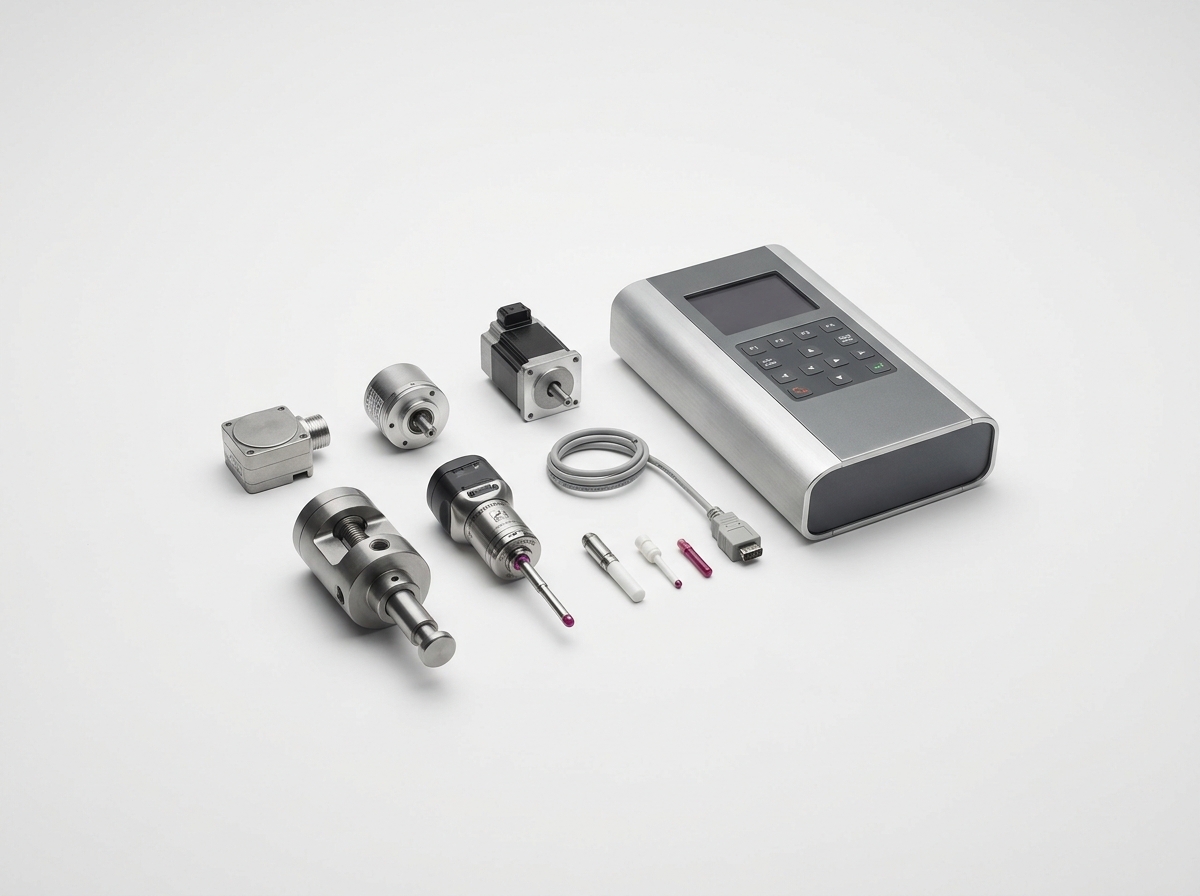
The cables and connectors page matters because signal integrity often determines whether the system can hold precision under real machine shop noise.
| Power or wiring spec | What to inspect | Failure mode if weak |
|---|---|---|
| Supply stability | Voltage tolerance and grounding | Controller reset or alarm |
| Shielding | Encoder and drive cable shielding | Position noise and false counts |
| Connector quality | Locking and contact reliability | Intermittent axis faults |
| Cabinet heat | Ventilation and thermal load | Reduced component life |
Good cable routing and grounding are not glamorous, but they are often the difference between a stable machine and a recurring service call.
Accuracy, repeatability, and the standards buyers should use
Accuracy claims should be checked against standards, not slogans.
For CNC buyers, the relevant question is whether the controller supports the machine accuracy that the shop actually needs. ISO standards help define how accuracy is measured, which makes them a better buying reference than promotional language.
ISO 230-2:2014 is especially useful because it addresses positioning accuracy and repeatability, the two outcomes that most directly affect part quality in production.
Buyers should also remember that the controller is only one part of the accuracy chain. Mechanical wear, backlash, thermal drift, and encoder installation all influence final performance.
| Metric | What it tells you | Why controller buyers care |
|---|---|---|
| Positioning accuracy | How close commanded and actual positions are | Impacts hole location and contour quality |
| Repeatability | How consistently the machine returns to a point | Impacts batch consistency |
| Geometric error | Axis squareness and machine alignment | Impacts large-part machining |
| Thermal stability | Drift over time and load | Impacts long-run production quality |
When machine builders publish precision claims, the buyer should ask whether those claims were verified with accepted test methods and under controlled conditions.
How to compare CNC controller specs before buying
The best buying method is to compare control system specs in the order that actually affects machine uptime.
Start with compatibility, then move to motion performance, then to automation expansion, and only then to price. This sequence prevents the common mistake of buying a controller that looks advanced but cannot be integrated without extra converters, custom wiring, or software workarounds.
- List the machine model, axis count, spindle requirements, and existing drive type.
- Identify the feedback devices already installed, including encoder format and resolution.
- Check I/O count for probes, tool setters, clamps, coolant, and interlocks.
- Review cabinet power, heat, and cable routing before final purchase.
- Confirm the service path: spare parts, manuals, and replacement lead time.
If your project includes motion replacement rather than a new build, compare the CNC retrofit kits page alongside the controller itself, because retrofit success often depends on the full package rather than a single component.
Real buying scenarios: what different users should prioritize
Different buyers need different controller specs because different shops define success differently.
A job shop replacing a failed machine usually prioritizes quick compatibility and minimal downtime. A mold shop may care more about fine interpolation, surface finish, and stable feedback. An automation cell builder usually needs abundant I/O and robust fieldbus support. These are not cosmetic differences; they are structural buying priorities.
| Buyer type | Primary priority | Secondary priority | Common mistake |
|---|---|---|---|
| Maintenance team | Fast replacement | Exact compatibility | Buying by price alone |
| Precision shop | Repeatability | Feedback quality | Ignoring encoder details |
| Automation builder | I/O scalability | Network protocol | Running out of signals later |
| Retrofit buyer | Legacy machine match | Spare parts support | Assuming adapters solve everything |
For global buyers, multilingual part naming and model consistency also matter because misread part numbers can create avoidable ordering errors across regions.
FAQ about CNC controller system specs
What is the first spec to check in a CNC controller system?
Compatibility is the first spec to check, especially controller family, drive protocol, feedback type, and machine voltage class. A technically strong controller is still a bad purchase if it cannot communicate with the machine.
How do I know if a controller works with my servo drives?
Check the command interface, feedback support, current rating, and supported network or pulse format. The controller and drive must share the same motion logic and electrical assumptions.
Why does encoder compatibility matter so much?
Because the encoder is the feedback core of closed-loop control. If the controller cannot read the encoder correctly, positioning, repeatability, and fault handling all degrade.
How many I/O points do I need?
Count every real function first: probes, tool setters, clamps, coolant, door interlocks, limits, alarms, and auxiliaries. Then add expansion capacity if you expect future automation.
Is price ever a good way to choose a controller?
Price only makes sense after compatibility, axis support, feedback format, and I/O capacity are verified. Otherwise, low cost can become high downtime.
Should I replace the whole system or just the controller?
If the existing drives, encoders, or wiring are old or undocumented, a broader retrofit may reduce risk. If the machine is well documented and the fault is isolated, controller replacement may be enough.
What standards help evaluate controller-related accuracy?
For machine tool performance, ISO 230-1:2012 and ISO 230-2:2014 are the most useful starting points because they frame accuracy and repeatability in measurable terms.