










- Oil mist control is a production reliability issue, not only an environmental one.
- Continuous production lines benefit most when mist capture is sized to machine enclosure leakage and coolant atomization rate.
- Cleaner air can reduce residue buildup on cabinets, sensors, and floors, improving uptime and safety.
- Selection should consider airflow, filtration stages, noise, maintenance interval, and integration with the machine enclosure.
- For 24-hour operations, the lowest-risk choice is the system that prevents contamination before it becomes downtime.
In a 24-hour CNC production line, an oil mist collector is part of process stability, not an optional add-on. OSHA states that general industry noise exposure should not exceed 90 dBA over an 8-hour time-weighted average, and mist control often has to coexist with acoustic and ventilation constraints while the line keeps running. For shops running unattended second shifts or lights-out machining, the practical goal is simple: protect people, keep the machine surfaces clean, and avoid contamination that can interrupt precision work. That is why many buyers compare air-management needs alongside core machine-side components such as spindle motors, tool probes, and tool setters when planning continuous operation.
Why an oil mist collector matters in continuous production and shop air quality
Continuous production magnifies every small contamination problem.
On a single-shift machine, light mist may be annoying; on a 24-hour line, it compounds into residue on glass, cabinets, fixtures, and walking paths. That residue can interfere with photoelectric sensors, create slippery floors, and force unplanned cleaning stops. It can also make preventive maintenance harder because oil films trap chips and dust, turning a manageable cleanout into a deeper service event.
For OEM-style planning, the key is not only capture efficiency but also capture consistency over long duty cycles. A collector that performs well for one hour but drops in flow as filters load is a weak fit for continuous production. This is why buyers should evaluate differential pressure monitoring, filter access, and maintenance labor just as carefully as they review spindle speed or servo torque.
How oil mist develops in CNC machining environments
Oil mist forms when cutting fluids, way oils, or lubrication media are atomized by high-speed rotation and chip impact.
The main drivers are spindle speed, coolant delivery pressure, enclosure sealing, and cutting strategy. Higher RPM increases atomization risk, while high-pressure coolant can turn a poor enclosure into a mist leak path. Grinding, high-speed milling, and turning with aggressive through-tool coolant are common situations where airborne droplets become visible or measurable.
For example, a shop running high-duty spindle systems and motion components such as CNC motors and 4th axis units may see higher aerosol load simply because the machine is operating more aggressively and for longer periods. The more hours the machine runs, the more important it becomes to remove mist before it re-circulates through the enclosure or leaks into the shop.
| Mist source | Typical production trigger | Operational risk | Collector priority |
|---|---|---|---|
| High-speed milling | High RPM, open chip flow | Cabinet residue, sensor fouling | High |
| Turning with coolant | Continuous chip breakup | Floor slip risk, odor | Medium to high |
| Grinding | Fine aerosol generation | Air quality degradation | High |
| Through-tool coolant | Pressure-driven atomization | Leakage around doors and seals | High |
What a 24 hour CNC production line should look for in an oil mist collector
A 24-hour line should prioritize stable capture, easy service, and measurable compatibility with the machine enclosure.
The first filter stage should handle larger droplets, while downstream media or coalescing stages should capture finer aerosol. In continuous work, filter loading matters as much as initial performance, because a unit that clogs quickly creates rising energy consumption and falling airflow. Noise also matters in round-the-clock shops, especially where operators share space with multiple machines.
When comparing options, it helps to think like a controls buyer. Just as a power supply must provide stable voltage and an I/O module must fit the machine logic, an oil mist collector must fit the actual duty cycle, coolant chemistry, and enclosure size. The wrong unit may run, but it will not necessarily protect the line.
| Selection factor | Why it matters in 24/7 production | Practical buying question | Example target |
|---|---|---|---|
| Airflow capacity | Determines capture strength | Can it keep up when doors open? | Matched to enclosure leakage |
| Filtration stages | Determines fine mist control | Does it use staged separation? | Multi-stage design |
| Noise level | Affects operator comfort | Can it run all shift without nuisance? | Low enough for shared shop floor |
| Maintenance interval | Impacts downtime | How often are filters serviced? | Service-friendly access |
| Integration | Supports automation | Can it interlock with machine status? | Alarm or run signal compatibility |
Quantitative standards and why they matter for mist, air, and safety
Quantitative limits help shops decide whether a collector is solving the right problem.
OSHA’s permissible exposure limit for mineral oil mist is 5 mg/m3 as an 8-hour time-weighted average, which gives production teams a concrete benchmark for risk management. For ventilation design, the ACGIH standard for thermal comfort and the broader ASHRAE and industrial hygiene guidance are often used alongside plant-specific measurement, but the key point remains: if the mist is visible, sticky, or persistent, the line is already spending money on a problem it could reduce upstream.
For metrology-minded buyers, machining accuracy and environmental control are connected. ISO 230-1:2012 defines test conditions for machine tool performance evaluation, including geometric and positioning-related assessments that are influenced by cleanliness and thermal stability. A dirty enclosure does not automatically break tolerance, but it increases the number of variables the controls team has to manage.
Another useful benchmark comes from vibration and repeatability discipline. If a machine relies on linear scales or precision feedback components, residue around scale readers, seals, and cable routes can create avoidable service calls. The business case is not abstract: fewer contamination events usually mean fewer short stoppages, fewer manual cleanups, and better consistency across long shifts.
| Reference | Value | Why it matters | Source type |
|---|---|---|---|
| Mineral oil mist exposure limit | 5 mg/m3 TWA | Worker exposure benchmark | OSHA |
| Noise exposure limit | 90 dBA over 8 hours | Collector and shop acoustic planning | OSHA |
| Machine tool test standard | ISO 230-1:2012 | Performance verification framework | ISO |
| Airborne particle control principle | Measured, not assumed | Use instrumentation to verify improvement | NIST |
How oil mist collectors affect uptime, maintenance, and scrap risk
An oil mist collector can reduce hidden maintenance costs that are easy to overlook in cost-per-part calculations.
When mist coats machine cabinets, fans, and connectors, technicians spend more time on cleaning and inspection. When residue collects on floors, housekeeping cycles increase. When sensors and limit switches get film buildup, troubleshooting becomes harder because the symptom looks electrical even when the root cause is environmental. In a 24-hour production line, each of those events consumes labor and creates uncertainty.
Scrap risk is less direct but still real. If contamination leads to inconsistent probing, dirty fixturing surfaces, or thermal drift from clogged ventilation, the line may produce borderline parts that fail downstream inspection. That is why many plants consider an oil mist collector together with probes and bearings when building a reliability plan for unattended machining.
In practical terms, the collector pays off when it turns recurring micro-stops into stable operation. Even a small reduction in manual cleaning can matter when a machine runs 6,000 to 8,000 productive hours per year, which is common in high-utilization environments according to industry estimates.
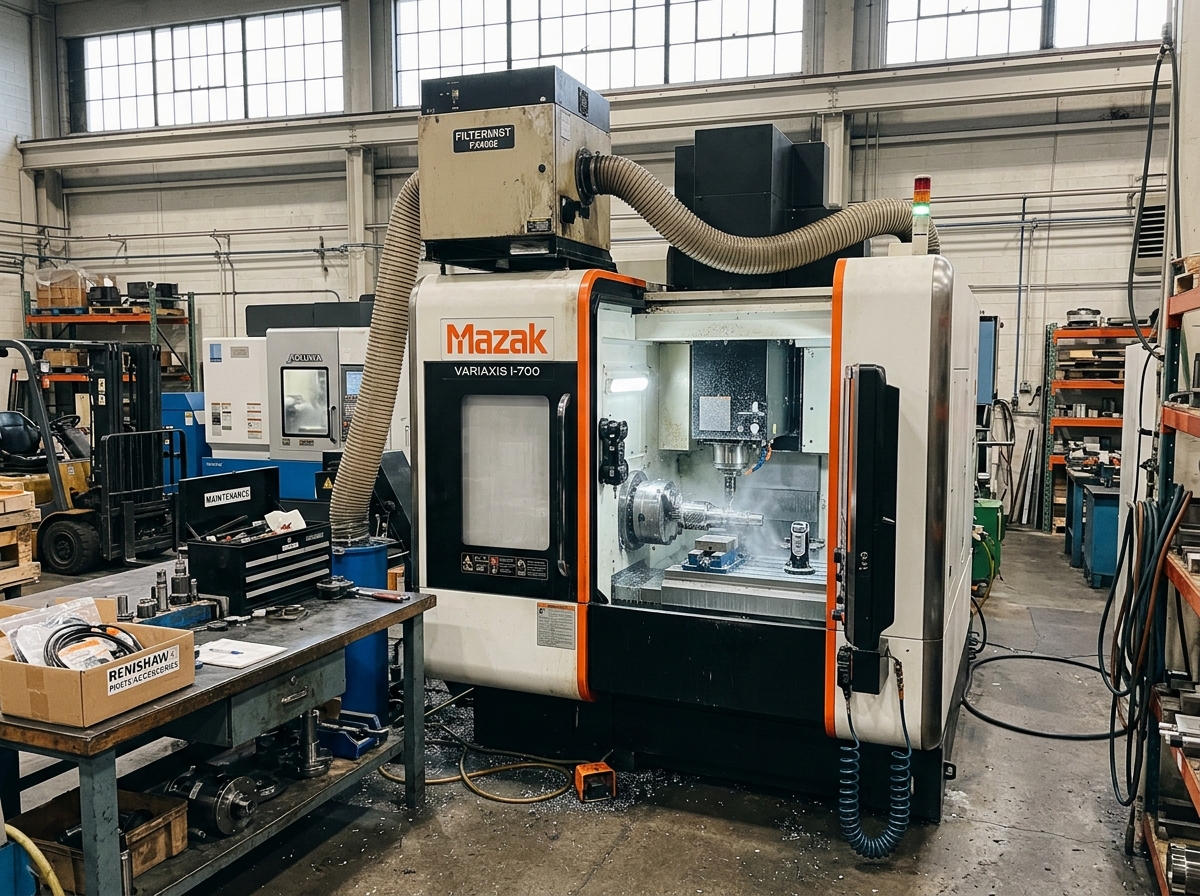
Choosing the right oil mist collector for shop air quality
The best oil mist collector is the one that matches the machine, the coolant, and the runtime profile.
Start with the source. A high-speed mill with frequent door openings needs a different strategy than a closed turning cell with stable coolant delivery. Then check the collector’s airflow, serviceability, and filter media. Finally, confirm whether the unit can be mounted, ducted, or interlocked without compromising the machine’s own enclosure integrity.
A useful rule is to evaluate the collector the same way you would evaluate a critical spare: compatibility first, performance second, and price third. That logic is familiar to buyers of CNC parts and NSK bearing replacements, where the real cost of the wrong choice is downtime, not just the invoice amount.
- Measure the dominant mist source: coolant type, RPM, and enclosure leakage.
- Estimate operating hours and service intervals for a 24-hour line.
- Match airflow capacity to the machine enclosure and opening frequency.
- Check filtration stages, drain management, and maintenance access.
- Confirm noise, power, and mounting constraints before purchase.
Common mistakes when buyers evaluate oil mist collectors
The most common mistake is buying by nominal airflow alone.
Two collectors with the same rated airflow can behave very differently once filters load, ducts bend, or seals leak. A second mistake is ignoring coolant chemistry. Synthetic, semi-synthetic, and straight oil fluids can generate different aerosol behavior, which changes capture and drainage requirements. A third mistake is treating maintenance as an afterthought. In continuous production, the “best” system is often the one technicians can service quickly without shutting down the entire cell.
A fourth mistake is separating environmental control from machine reliability. For example, if a plant invests in precision components like ball screws and couplings but lets oil film build up around the enclosure, it is solving motion precision while ignoring contamination pressure. The two problems are connected.
When an oil mist collector should be upgraded or replaced
An oil mist collector should be upgraded when visible residue, odor, or maintenance load rises even though machine settings have not changed.
Other warning signs include clogged filters that shorten service intervals, rising noise, recurring leakage around the enclosure, or staff complaints about floor slickness and cabinet film. If an older unit was sized for intermittent work, it may simply be undersized for modern 24-hour utilization, especially after spindle upgrades, higher coolant pressure, or new automation has increased run time.
For plants adding a new cell, it is often easier to specify mist control during the expansion than to retrofit after contamination has already spread through the room. That is especially true when the same facility is already coordinating motion, feedback, and automation parts such as servo motors and handwheels for setup and verification.
FAQ about oil mist collectors for 24 hour CNC production lines
1. Is an oil mist collector necessary for every CNC machine?
No, but it becomes highly valuable when the machine runs long hours, uses oil-rich coolant, or produces visible aerosol that escapes the enclosure. The longer the runtime, the more a collector helps reduce residue, odor, and cleanup.
2. Does an oil mist collector improve machine precision?
Indirectly, yes. It does not change the machine’s inherent accuracy, but it can reduce contamination on sensors, scales, connectors, and work surfaces, which helps preserve stable operation and reduce avoidable variation.
3. What is the best sign that a collector is undersized?
Persistent mist outside the enclosure, sticky deposits on nearby surfaces, rising filter loading, or stronger odor at the operator station are common signs that the unit is not keeping pace with the source.
4. How often should filters be serviced in continuous production?
There is no universal interval. Service frequency depends on mist load, coolant type, and duty cycle. The best practice is to use pressure drop, visual inspection, and runtime data rather than waiting for a failure.
5. Can a collector help with shop safety?
Yes. By reducing airborne oil droplets and residue on floors and machine exteriors, a collector can support better housekeeping and lower slip risk in high-traffic production areas.
6. Should I choose airflow capacity or filtration efficiency first?
Choose both in balance, but airflow matching to the enclosure is usually the first filter. If airflow is too low, even high-efficiency filtration will not capture enough mist at the source.
7. How does this relate to other CNC spare parts decisions?
The same principle applies: compatibility matters more than price. Whether you are selecting an oil mist collector, a servo driver, or an power supply, the wrong match creates downtime and extra labor.